
Freezer Not Freezing: Common Causes and Repair Clues
Freezer not freezing properly? Use temperature, airflow, frost, loading, and door-seal clues to narrow the cause before requesting appliance repair.
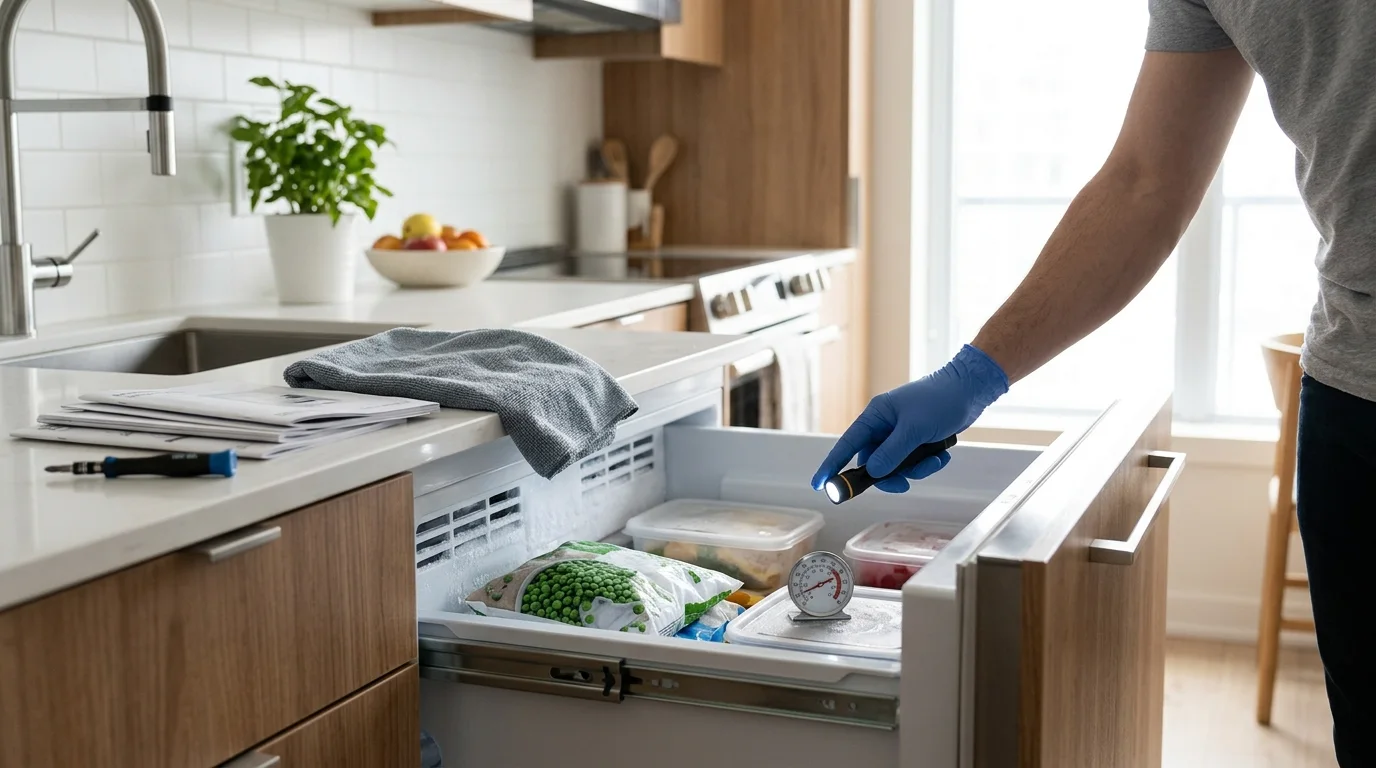
A freezer that stops freezing can stem from something as simple as an incorrect temperature setting or blocked airflow, but it can also involve the defrost system, fans, sensors, electrical controls, or the sealed refrigeration system. The useful first question is not which part has failed. It is whether the freezer is completely warm, still cold but not freezing food solid, or losing temperature only under certain conditions.
Freezer Not Freezing: Check the Actual Temperature First
Food can feel cold even when the freezer is too warm for dependable frozen storage. Health Canada recommends keeping a freezer at -18 degrees Celsius (0 degrees Fahrenheit) or below. If you are unsure whether the appliance is maintaining that temperature, use a freezer thermometer rather than judging only by how the packages feel. Health Canada’s safe food storage guidance provides the current Canadian temperature recommendation.
Treat food safety as a separate issue from the appliance diagnosis. The fact that the freezer is running, making noise, or still producing some cold air does not mean food has remained at a safe frozen-storage temperature. If food has thawed or the temperature history is uncertain, use current food-safety guidance rather than relying on an appliance troubleshooting rule of thumb.
When to Stop Using the Freezer
A freezer that is simply too warm is usually an appliance-performance problem, but electrical or sealed-system warning signs change the situation. Stop using the appliance and arrange an assessment if you notice any of the following:
- Burning odour, smoke, sparking, or visible scorching. Switch the appliance off if it can be done safely and do not keep resetting a breaker that trips repeatedly.
- A damaged power cord, hot plug, or discoloured receptacle. Do not continue operating the freezer until the electrical condition is checked.
- Persistent hissing accompanied by oily residue around refrigeration tubing or the compressor area. Do not disturb the tubing or attempt a refrigerant repair.
- The compressor area is unusually hot and the unit is repeatedly clicking without establishing normal cooling. Leave the appliance off if the behaviour is accompanied by an electrical smell or repeated breaker trips.
If none of those warning signs are present, you can continue with safe external observations while protecting the food separately.
Symptom Patterns That Help Narrow the Problem
The freezer is cold, but food is soft or not frozen solid
This pattern often means the system is producing some cooling but cannot maintain the temperature or distribute cold air effectively. Start with temperature settings, door sealing, blocked vents, heavy loading, and frost buildup before assuming a compressor problem. A fan that is not moving air correctly or a defrost issue that gradually blocks the evaporator can create the same complaint.
How quickly the problem developed matters. A freezer that became weak immediately after being packed tightly has a different diagnostic story from one that gradually lost freezing performance over several weeks while frost accumulated on the rear interior panel.
The freezer and refrigerator sections are both warming
On a refrigerator-freezer combination, warming in both sections broadens the cause list. Power, condenser airflow, control settings, fan operation, compressor starting, and sealed-system performance all become relevant. The symptom still does not prove that the compressor has failed. A control or start-component fault can prevent a healthy compressor from operating normally, and a severe airflow problem can reduce cooling throughout the cabinet.
The freezer is warm after a power interruption or move
After a power interruption, confirm the cooling function is actually turned on and that the controls did not enter a demo or showroom mode. Some models require model-specific steps after a power event. After the appliance has been moved, installation clearance, door alignment, and the time allowed for temperature recovery can also matter.
Health Canada provides separate food-safety guidance for power outages, including how long a closed freezer can generally hold frozen conditions. That outage guidance should not be applied to a mechanical cooling failure, which can have a very different temperature history. A freezer that is powered but malfunctioning has a different temperature history and must be judged by actual food condition and temperature.
The freezer runs almost constantly but still will not freeze properly
Continuous operation means the control system is trying to reach temperature but the cabinet is not satisfying the demand. Possible cause groups include warm air entering through a poor door seal, restricted condenser heat transfer, weak evaporator airflow, heavy frost on the evaporator, inaccurate temperature sensing, or a refrigeration-system problem. The run time itself tells you the freezer is struggling, not why.
Loading and Room Conditions Can Change Freezer Performance
A freezer can struggle temporarily even when no component has failed. Loading a large amount of unfrozen food at once adds a major heat load, and tightly packed packages can block the air paths that distribute cold through the cabinet. Very warm surrounding temperatures can also increase how hard the appliance has to work, especially for units installed in garages or other spaces where the manufacturer specifies an operating-temperature range.
The useful question is whether the freezer recovers after the loading, door, or airflow condition is corrected. If measured temperature steadily returns toward the proper setting, that points away from a persistent mechanical failure. If it remains too warm, frost keeps building, a fan is not operating as expected, or the compressor repeatedly tries to start without establishing cooling, the temporary-condition explanation becomes less convincing. This is another reason to use measured temperature and symptom history rather than jumping from a single soft package to a parts assumption.
Common Cause Groups for a Freezer Not Freezing
Settings, power, and operating mode
Before looking for a failed component, confirm the freezer is powered, cooling is enabled, and the control setting is appropriate. Current Whirlpool product guidance includes checks for power, cooling mode, temperature settings, overloading, room conditions, and condenser cleanliness. Those are useful first filters because they can produce poor cooling without an internal component failure.
A digital display can also be misleading if it shows the set temperature rather than the measured cabinet temperature. A separate freezer thermometer gives you a more useful reference when the complaint is “it feels cold but the food is soft.”
Door seal and warm-air infiltration
A freezer has to keep humid room air out while maintaining sub-zero temperatures inside. A torn gasket, food package caught in the door, misaligned door, or debris on the sealing surface can allow a small but continuous flow of warm air into the cabinet. The compressor may run longer, frost may increase, and food near the door can soften first.
Chest and upright freezers can show this differently. A chest-freezer lid that does not sit flat may leak air around part of its perimeter, while an upright freezer may show a visible gap or condensation around one section of the door seal.
Blocked airflow or evaporator-fan problems
Many freezers depend on an evaporator fan to move cold air across the cabinet. Food packed directly against vents can reduce circulation even when the cooling system is working. A failed or obstructed fan can leave one zone very cold while another stays too warm.
Listen for normal fan operation, but remember that fan behaviour varies by model and some units stop the fan when a door is open. A quiet freezer does not prove the fan has failed. Many models stop the evaporator fan when the door is open, so the model’s normal behaviour has to be known before drawing that conclusion.
Frost buildup and defrost-system faults
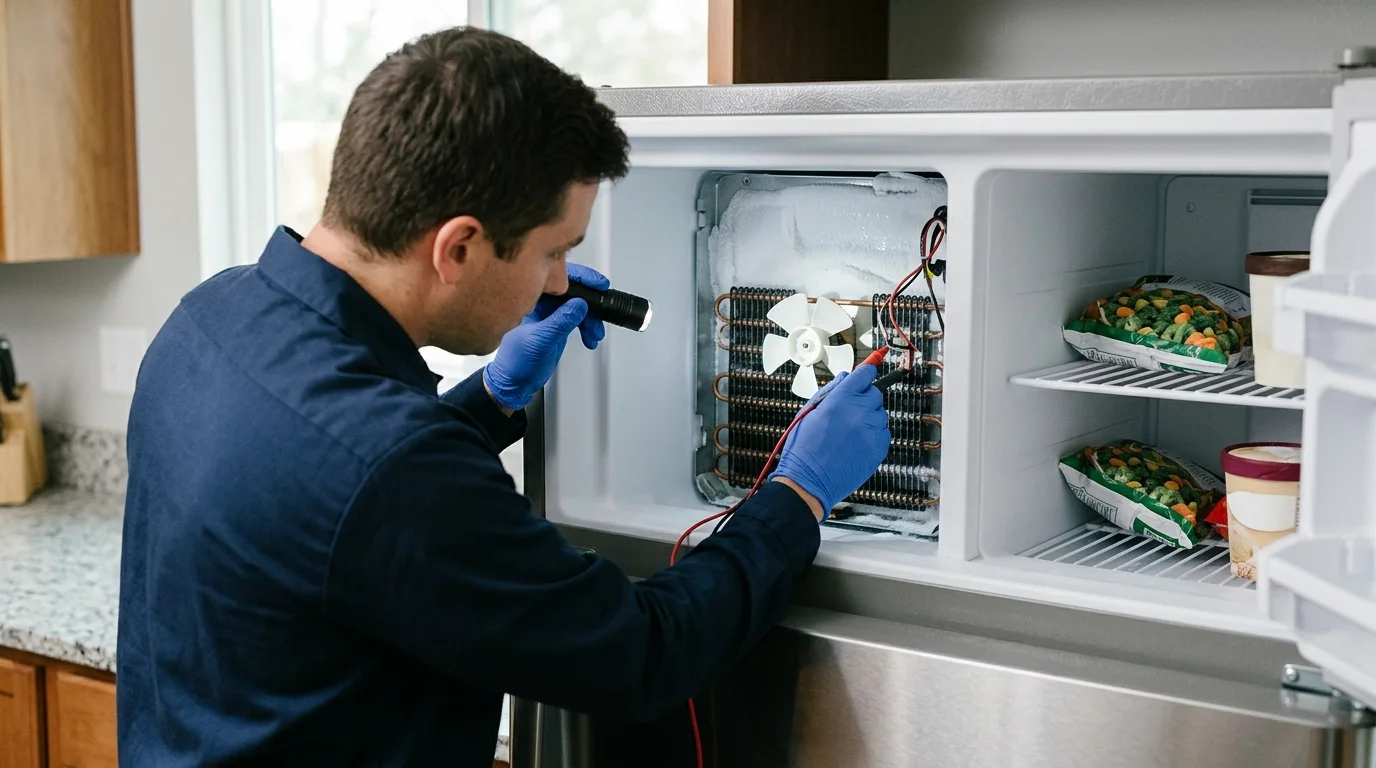
Frost-free appliances periodically clear frost from the evaporator. If that process stops working, ice can build over the coil and restrict airflow until the freezer can no longer maintain temperature. The root cause may involve a heater, sensor, thermostat, control function, wiring, or another model-specific part of the defrost system.
Heavy frost on an interior rear panel is a useful clue, but it is not a diagnosis by itself. A door left ajar can also create abnormal frost. The technician’s job is to separate excess moisture entry from a defrost-system failure before recommending a part.
Condenser heat-transfer problems
The refrigeration system has to release heat to the room. On models with accessible condenser coils, heavy dust buildup reduces heat transfer and forces the refrigeration system to run longer to compensate. Some modern designs have concealed condensers that are not intended for routine homeowner cleaning, so follow the owner’s manual before removing panels or assuming the coils should be exposed.
Sensor, control, and compressor-starting problems
Temperature sensors and electronic controls tell the refrigeration system when to run. A bad reading, failed relay or start device, loose connection, or control fault can prevent normal compressor and fan operation. Clicking from the compressor area may be relevant evidence, but it should not be treated as proof that the compressor itself has failed.
Sealed-system or compressor problems
The sealed system includes the compressor, refrigerant circuit, evaporator, and condenser. A refrigerant leak, internal restriction, or compressor problem can cause poor or absent freezing, but those faults cannot be confirmed by touch, sound, or a single visual clue. Proper diagnosis requires refrigeration-system testing and model-specific service information.
Safe Checks a Homeowner Can Make
Keep your checks limited to settings, food placement, visible sealing surfaces, accessible ventilation, and observations that do not require opening the refrigeration circuit or working on live wiring.
- Measure the temperature. Place a freezer thermometer where it can be read without leaving the door open for long. Compare the result with the -18 degrees Celsius storage recommendation.
- Confirm the control setting and cooling mode. Check the owner’s manual if the display or control labels are not clear.
- Inspect the door or lid seal. Remove food or debris preventing closure and look for obvious tears, distortion, or gaps.
- Clear blocked interior vents. Rearrange packages so air passages are not covered and the door can close without interference.
- Look for unusual frost patterns. A heavy frost sheet on an interior panel is useful information to report, especially if it returns after the cabinet has been properly defrosted according to the manufacturer’s instructions.
- Check external ventilation and accessible coils. If the manual identifies homeowner-accessible condenser cleaning, unplug the appliance first and follow that procedure. Do not remove sealed or electrical covers simply to reach coils.
- Listen and observe. Note whether you hear fans, a steady compressor sound, repeated clicking, or long silent periods. Record the pattern rather than assigning a failed part to it.
Why “Cold” and “Freezing Properly” Are Different
A freezer can feel cold while being many degrees warmer than its intended storage temperature. Ice cream becoming soft, loose ice cubes sticking together, or frozen packages becoming flexible are practical signs that the cabinet may be hovering above proper freezing conditions even though cold air is still present.
This distinction is diagnostically useful because partial cooling often means the refrigeration system is doing some work. The next question becomes whether heat is entering faster than the system can remove it, whether airflow is not distributing cold correctly, or whether the cooling system itself has lost capacity. That is more informative than jumping directly from “food is soft” to “compressor failure.”
What a Technician May Inspect or Test
A professional diagnosis usually starts with the actual cabinet temperature and the symptom history, then works through the systems that could produce that pattern. The sequence changes depending on whether the freezer is completely warm, weak but running, heavily frosted, or intermittently recovering.
The technician may inspect the door seal and cabinet alignment, verify evaporator and condenser fan operation where applicable, check the evaporator frost pattern, test defrost components, evaluate temperature sensors, inspect compressor-start components, and review control-board outputs or stored diagnostic information when the model provides it.
If the basic electrical, airflow, and defrost systems check out but the freezer still cannot reach temperature, sealed-system testing becomes relevant. That can include checking compressor operation and refrigeration-system pressures using the proper equipment. The purpose is to confirm the fault before an expensive component is recommended.
Repair or Replace Depends on What Failed
A freezer not freezing is a symptom, not a repair category. A dirty sealing surface, failed fan, sensor, defrost component, or start device can lead to a very different repair decision from a sealed-system problem on an older appliance.
After diagnosis, compare the repair scope with the freezer’s overall condition, history of problems, parts availability, capacity needs, energy use, and the cost and features of a comparable replacement. Avoid applying one universal age cutoff or percentage rule to every freezer.
When to Request Appliance Repair
If the freezer remains above its proper temperature after settings, door closure, loading, and accessible airflow checks have been addressed, a professional assessment is the practical next step. The same applies when frost repeatedly returns, the fan or compressor behaviour is abnormal, the unit repeatedly clicks without cooling, or an electrical warning sign is present.
For service information, see the freezer repair page. You can also Request Appliance Repair to connect with an independent appliance repair contractor serving your area.
Need Appliance Repair?
Share the appliance, brand, address, symptoms and optional photos online. A contractor can review the request and contact you about availability and next steps.
Start Your Repair Request