
Heat Pump Will Not Turn On: Power and Control Clues
Heat pump not turning on? Check thermostat settings, breakers, delays and airflow, then use system clues to know when professional diagnosis is needed.
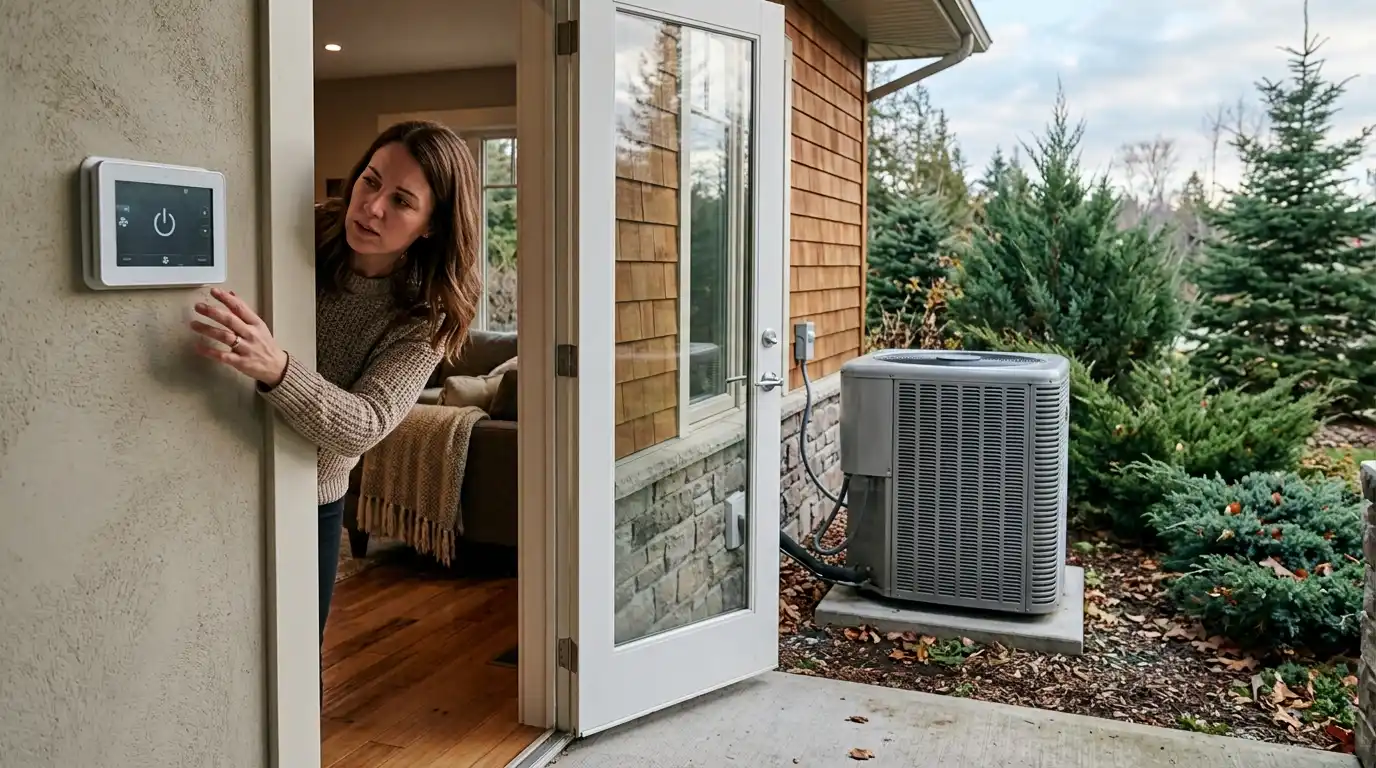
A heat pump not turning on does not automatically mean the compressor or another major component has failed. The cause may be as simple as an incorrect thermostat setting, a blank display, a temporary startup delay, a tripped breaker, or restricted airflow. It may also involve a control, motor, capacitor, contactor, wiring, or refrigerant problem that requires professional testing.
The most useful starting point is to observe exactly what happens when the thermostat calls for heating or cooling. Does the thermostat display remain on? Does the indoor blower start? Do you hear a click, hum, or buzzing sound? Does the outdoor unit remain completely silent? Does the system start briefly and stop again? These details do not identify a failed part by themselves, but they can narrow the group of possible causes.
This guide focuses on visible clues and checks that do not require opening equipment panels, changing wiring, forcing electrical contacts, or handling refrigerant. Heat pump designs vary, so the manufacturer instructions for the specific system should take priority over general advice. Trane also recommends checking basic thermostat and power conditions before more advanced diagnosis, and its troubleshooting guidance is available at Trane’s heat pump troubleshooting resource.
For a related next step, read heat pump installation Mississauga.
Start with the Thermostat
A thermostat must send a call for heating or cooling before the heat pump will begin its normal operating sequence. If the display is blank, the system may not be receiving a signal from the thermostat at all. A blank display can result from dead batteries, loss of thermostat power, a wiring issue, or a thermostat fault. Replace batteries only if the thermostat uses them and the procedure is clearly described in the manufacturer’s instructions.
If the display is active, check the operating mode and temperature setting. In heating mode, the set temperature must be above the room temperature. In cooling mode, it must be below the room temperature. A thermostat that is set to Off, Fan Only, or an incorrect mode may appear to be working while never sending the call the heat pump needs.
Also check whether the fan is set to Auto or On. The fan setting controls how the indoor blower behaves, but it does not necessarily make the outdoor heat pump operate. With the fan set to On, the blower may run continuously even when the system is not heating or cooling. That can make a control or outdoor-unit problem look like a complete system failure.
Some thermostats intentionally delay startup after a mode change or power interruption. This protects the equipment from rapid cycling and allows pressure in the system to stabilize. Wait through the normal delay shown in the equipment or thermostat instructions. A short pause is different from a system that remains inactive indefinitely, repeatedly starts and stops, or fails to respond after the call has been active.
What the System Does After a Call
A heat pump does not operate as one single switch that turns every component on at exactly the same moment. The thermostat communicates a demand to the control system. Depending on the design, the indoor air handler or furnace may respond first, while the outdoor unit starts after a short delay. Safety controls can also prevent operation if the system detects an abnormal condition.
This is why the order of events matters. If the indoor blower starts but the outdoor unit stays off, the thermostat may be calling for operation while the outdoor section is not receiving power or is being held out by a control or safety condition. If the outdoor unit runs but the indoor air handler does not, the indoor power supply, blower control, fan motor, or related wiring may need attention. Neither pattern proves which part has failed.
Some heat pumps also change operating behaviour during defrost. In heating mode, frost can form on the outdoor coil in cold, damp conditions. A normal defrost cycle temporarily changes the system’s operation to remove that frost. The outdoor fan may stop, the system may make unfamiliar sounds, and steam can sometimes appear as ice melts. A brief change in operation is not the same as a heat pump that cannot start or a coil that remains heavily iced.
Persistent ice, repeated shutdowns, poor heating, or a unit that never returns to normal operation requires diagnosis. Do not chip ice from the coil, pour hot water over the outdoor unit, or remove panels to investigate the cause.
Power Clues Worth Checking
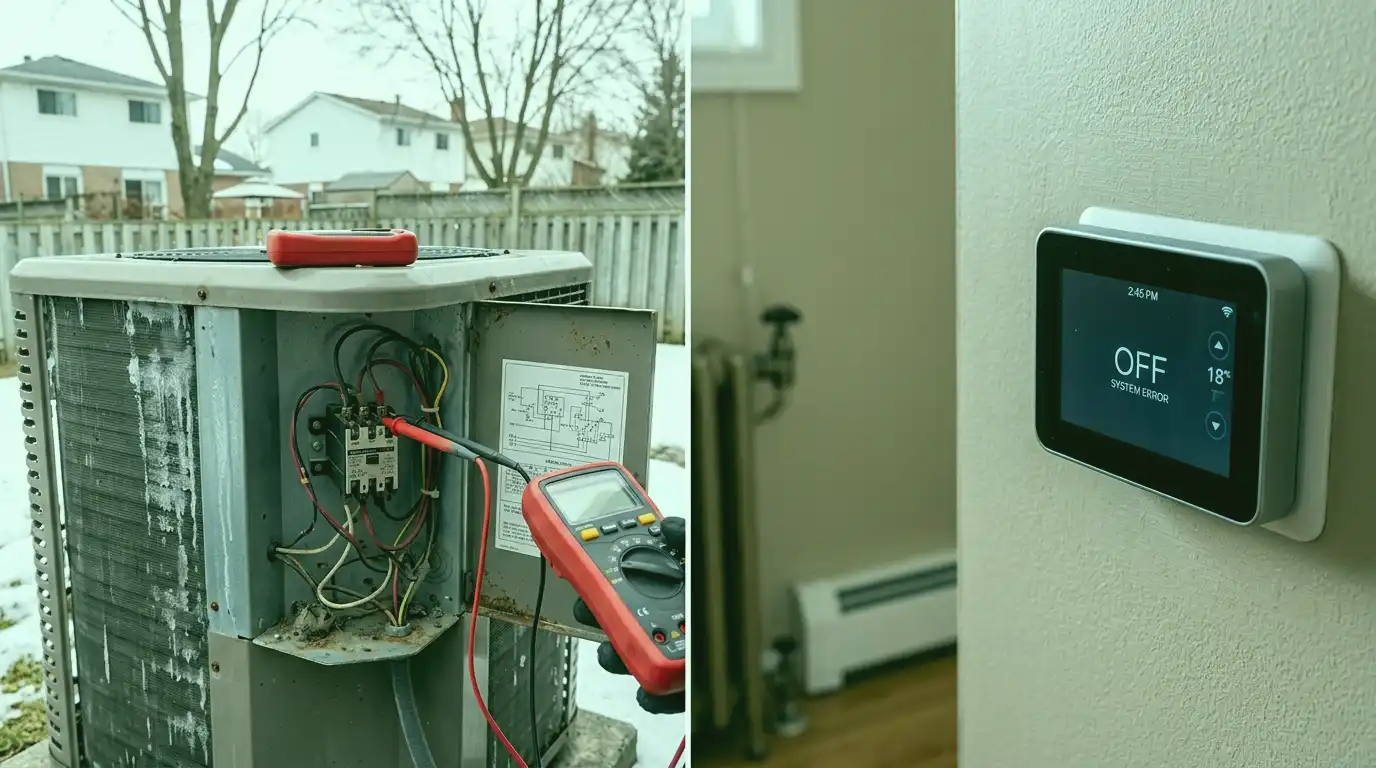
Heat pumps commonly have more than one power point to consider. The indoor air handler and outdoor unit may be supplied through separate breakers or disconnects. A thermostat can remain lit even when the outdoor equipment has lost power, so an active display does not prove that the entire system is energized.
At the electrical panel, look for a breaker that appears out of position or does not match the position of the other breakers. If the equipment instructions allow a homeowner to check the breaker, move it fully to the Off position and then once to the On position. Do not keep resetting it if it trips again. A repeated trip may indicate an electrical fault or an equipment problem that could worsen with continued attempts to restart the system.
Do not remove electrical covers or open service panels to search for another switch. Some systems have a nearby disconnect, but its design and location vary. If the disconnect is visibly damaged, loose, hot, or associated with a burning smell, leave it alone and arrange qualified service. Do not bypass a disconnect, bridge a contactor, or manipulate exposed wiring.
Power interruptions can also produce a temporary delay. After a reset or outage, allow the equipment to complete its normal waiting period. If there is still no response, or if the breaker trips again, the next step is testing rather than repeated resetting.
What Sounds Can Tell You
Sound is a useful clue because different operating responses suggest different points in the startup sequence. It is not a substitute for electrical and mechanical testing.
Complete Silence
Complete silence after a valid thermostat call may point toward a thermostat communication issue, lost power, a control preventing startup, or a failure in the equipment’s electrical path. Check the thermostat display and the obvious breaker condition without opening equipment. If those basic observations do not explain the silence, professional diagnosis is appropriate.
A Click Without Operation
A click may mean that a relay or contactor is responding to the call while another part of the startup sequence is not completing. It can also come from a control attempting to start equipment that has lost power or has another fault. Do not assume that the sound proves a bad contactor. A technician may need to verify the control signal, incoming power, component operation, and safety conditions.
Buzzing or Humming
Buzzing or humming without normal operation can be consistent with a motor, capacitor, contactor, wiring, or other electrical problem. A motor that hums but does not start can overheat if it remains energized. Turn the system off at the thermostat if it is making an unusual electrical sound, then arrange service. Do not attempt to start the fan by hand or reach through the grille while power may be present.
Indoor Operation Only
If the indoor blower runs but the outdoor unit does not, first consider whether the thermostat is calling for the correct mode and whether the outdoor section has power. A fan set to On can run independently of heating or cooling demand. If the thermostat settings are correct and the outdoor unit remains inactive, a control, wiring, power, motor, capacitor, or safety issue may be involved.
Short Operation and Shutdown
A heat pump that starts and stops quickly may be responding to a safety control, airflow restriction, control issue, abnormal operating condition, or another fault. Repeatedly forcing it to restart can make the original problem harder to diagnose and may place additional stress on the equipment. Record what starts, how long it runs, and what happens immediately before it stops.
Safe Airflow and Outdoor Checks
Restricted airflow can affect heat pump performance and may cause unusual cycling or poor heating and cooling. Check the air filter if it is accessible without removing equipment panels. A visibly loaded filter should be replaced with the correct type and size specified for the system. Avoid assuming that a thicker or more restrictive filter is suitable simply because it appears to capture more dust.
Check that supply and return vents are not blocked by furniture, rugs, storage items, or closed grilles. The indoor blower needs a reasonable path for air to move through the system. Closing many vents can change airflow and pressure in ways the equipment was not designed to handle.
At the outdoor unit, look for leaves, snow, grass, or other debris that blocks the coil or restricts the space around the cabinet. Remove loose material from the surrounding area without opening the unit or bending the coil fins. Do not use tools inside the grille, spray water into the cabinet, or try to clear ice by force.
Snow and frost require careful interpretation. A light layer of frost may occur during normal cold-weather operation, and the system may periodically defrost itself. Heavy ice that remains in place, blocks airflow, or returns quickly is not a routine condition to ignore. Turn the system off if it is struggling, making abnormal sounds, or repeatedly shutting down, and request service.
Keep the outdoor unit’s air path reasonably clear, but do not treat a generic clearance measurement as universal. Different systems have different installation requirements. The equipment manual and installation guidance should determine what space is needed.
Common Heat Pump Not Turning on Causes
Once the simple observations are complete, the likely cause groups can be organized by the clue the system is giving you.
Thermostat or Communication Problems
A blank display, incorrect mode, wrong setpoint, loose thermostat connection, or failed thermostat can prevent a call from reaching the equipment. A thermostat may also behave differently after a battery change or power interruption. If the display is active but the equipment does not respond, the thermostat is one possibility, but the wiring and equipment controls also need to be considered.
Breaker, Disconnect, or Supply Problems
A partially tripped breaker, separate outdoor disconnect, power interruption, or wiring fault can leave one part of the system operating while another remains inactive. Repeated breaker trips are a stopping point, not an invitation to keep trying. The cause could be in the supply or inside the heat pump, and determining which requires appropriate electrical testing.
Airflow Restrictions
A dirty filter, blocked return, closed vents, or outdoor debris can restrict the movement of air. Airflow problems may cause poor comfort, longer run times, freezing, or protective shutdowns. They do not necessarily mean the heat pump itself has failed. Correct only the obvious, low-risk obstruction and monitor the result. Persistent symptoms require further assessment.
Controls and Safety Devices
Heat pumps use controls and safety devices to coordinate the indoor and outdoor sections and to prevent operation under abnormal conditions. A failed control board, sensor, relay, or communication path may stop the system even when the thermostat appears normal. These components cannot be reliably diagnosed by sound or visual inspection alone.
Motors, Capacitors, and Contactors
Motors, capacitors, and contactors affect whether the outdoor fan and compressor can start. Clicking, humming, a fan that does not move, or an outdoor unit that attempts to start can point toward this cause group, but the same symptoms may arise from other faults. These components can involve stored electrical energy and high-voltage circuits. Do not remove panels or test them unless you are properly qualified and equipped.
Compressor or Refrigerant-Related Problems
A compressor or refrigerant issue can contribute to poor heating, poor cooling, unusual sounds, or protective shutdowns. A heat pump that will not turn on may have a fault in this area, but symptoms alone do not prove compressor failure or a refrigerant problem. Refrigerant handling and sealed-system diagnosis require appropriate equipment and training. A system that runs but does not provide the expected temperature change should be assessed rather than repeatedly restarted.
Checks to Avoid
Some troubleshooting suggestions found online cross an important safety boundary. Do not force a contactor closed, bypass a safety switch, bridge thermostat terminals, alter wiring, open an electrical panel, or reach into the outdoor unit while power may be present. Do not use a screwdriver to test whether a motor will start. These actions can cause shock, burns, equipment damage, or an unsafe condition that is not obvious afterward.
Do not repeatedly reset a breaker that trips. Do not chip away ice from a coil, pour boiling water over the unit, or use a heat source near wiring and plastic components. Do not add refrigerant based on a guess. A system that appears to start after an unsafe workaround is not necessarily repaired, and the workaround may conceal a condition that needs immediate attention.
When to Stop Troubleshooting
Arrange professional service when the thermostat and obvious airflow checks do not explain the problem, or when the system shows any warning sign such as:
- a breaker that trips again after one reset
- burning, melting, or electrical smells
- sparking, smoke, heat, or visible damage
- repeated clicking, buzzing, or harsh mechanical sounds
- heavy ice that does not clear through normal operation
- an outdoor unit that repeatedly starts and stops
- an indoor blower that runs without expected heating or cooling
- complete silence despite a correct thermostat call and available power
- water or refrigerant-like oily residue near the equipment
Turn the system off when it is producing a burning smell, sparking, smoke, or other immediate electrical warning. Keep clear of damaged equipment and use the appropriate emergency response for an active hazard. Do not open the cabinet to investigate.
What to Record Before Service
A few observations can help a technician begin efficiently. Note whether the thermostat display is blank or active, which mode is selected, whether the indoor blower runs, whether the outdoor fan moves, and whether you hear a click, hum, or repeated attempt to start. Record any breaker trip, unusual smell, ice buildup, error message, recent power outage, filter change, or change in performance.
Do not describe a component as failed unless it has been tested. Saying that the outdoor unit is silent or that the breaker trips gives useful information without locking the diagnosis to a part that may be innocent. If the system is a dual-fuel, ductless, geothermal, or other specialized design, include that information and the model number if it is safely available from the equipment label.
Repair or Replacement?
A heat pump that will not turn on does not justify replacement by itself. The decision depends on the confirmed fault, the equipment’s condition, expected repair scope, operating performance, maintenance history, and the owner’s longer-term plans. A thermostat, wiring, control, or airflow correction may be very different from a major sealed-system or compressor repair, but the difference should be established through diagnosis.
Ask what failed, how the conclusion was reached, whether the system has additional performance problems, and what risks remain if the repair is delayed. For an older system, a repair-versus-replacement discussion may be reasonable when diagnosis reveals a major component problem or recurring faults. For a newer system, preserving the existing equipment may make more sense when the fault is limited and the rest of the system is performing properly.
The Practical Diagnostic Path
For a heat pump not turning on, begin with the thermostat display, mode, setpoint, and any normal delay. Then observe whether the indoor and outdoor sections respond in the expected order. Check the obvious breaker condition, but do not repeatedly reset a breaker that trips. Inspect the accessible filter, vents, and outdoor area for restrictions without opening the equipment.
Those checks can separate a settings problem from a power clue, an airflow restriction, or a more serious equipment symptom. They cannot confirm a capacitor, compressor, contactor, control, motor, wiring, or refrigerant fault. When the basic observations do not restore normal operation, professional testing is the next useful step. The goal is not to guess the most expensive part. It is to identify where the startup sequence stops and correct the underlying problem safely.
Need Appliance Repair?
Share the appliance, brand, address, symptoms and optional photos online. A contractor can review the request and contact you about availability and next steps.
Start Your Repair Request