
Dryer Takes Too Long to Dry: Heat and Airflow Clues
Dryer Taking Too Long To Dry guide: learn the key details, compare options, check verified sources, and make a safer decision before you act.
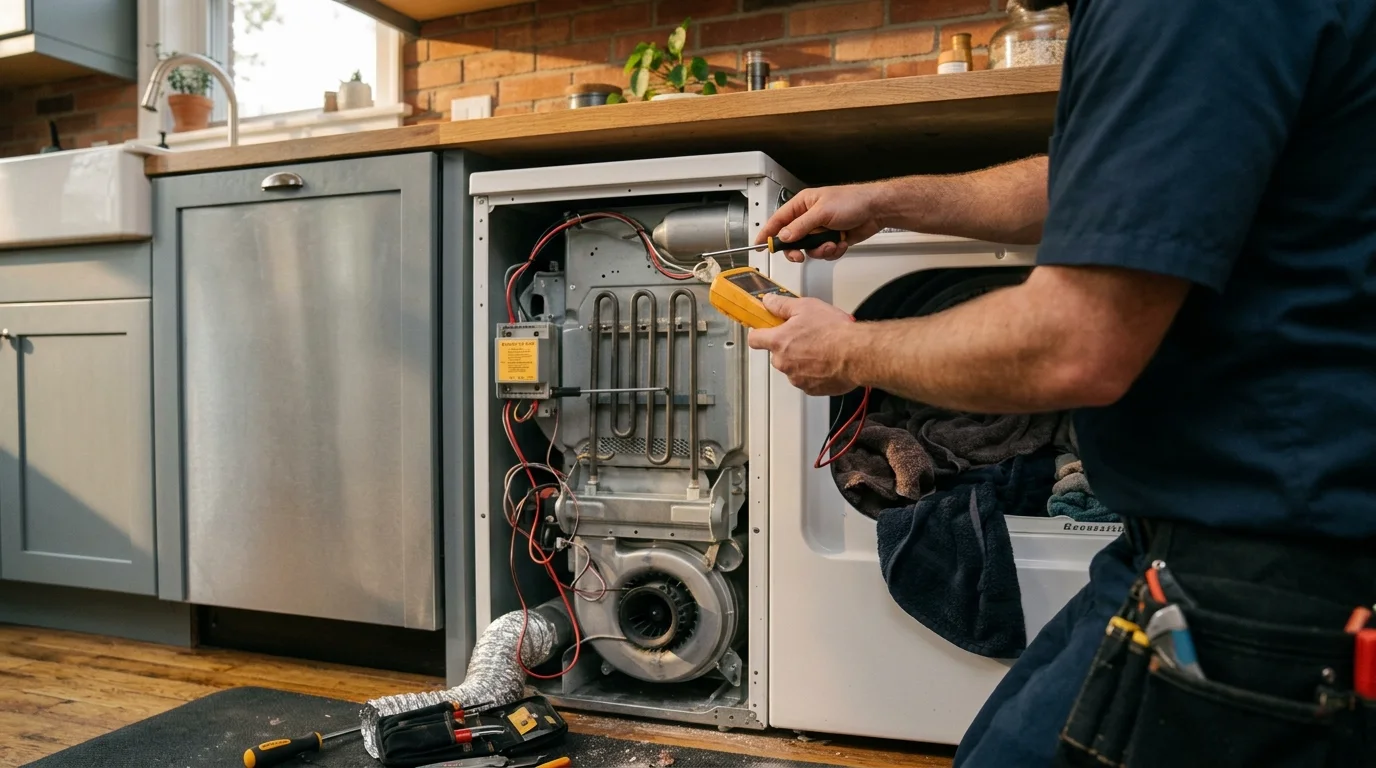
A dryer taking too long to dry usually needs one basic question answered first: is it making normal heat but failing to move moisture out, or is it not producing enough heat in the first place? Warm but damp clothes often point toward restricted airflow, an overloaded load, or cycle and sensor issues. Cool damp clothes make the heating system or energy supply more important suspects. The symptom pattern matters more than guessing at a part.
Why a Dryer Taking Too Long to Dry Is Often an Airflow Problem
Drying clothes requires more than heat. The dryer has to warm the fabric, move air through the tumbling load, pick up moisture, and exhaust that moisture outside. If any part of that airflow path is restricted, the machine can feel hot and still leave clothing damp.
Whirlpool’s current long-dry-time guidance specifically points owners toward the lint filter, load size, vent hose, exterior vent, and cycle selection. LG gives similar guidance when its dryers indicate restricted airflow. That makes airflow a sensible early branch in the diagnosis, but it does not mean every slow dryer has a clogged vent.
The other branch is heat. A dryer that is barely warm or completely cool after several minutes on a heated cycle needs a different diagnostic path from one that gets very warm but cannot finish a load.
Use the Clothes and the Heat Level as Clues
Clothes are warm but still damp after a full cycle. This is one of the clearest airflow clues. Heat is reaching the drum, but moisture is not leaving efficiently. A loaded lint screen, crushed transition duct, restricted house vent, blocked exterior hood, oversized load, or poor tumbling can all contribute.
Clothes are cool and damp. Confirm that a heated cycle is selected. If the setting is correct and there is still little or no warmth, the heating system, electrical supply, or gas heating system may need diagnosis.
The dryer gets unusually hot and the laundry room feels humid. Excess heat combined with slow drying often means the heat is staying near the appliance instead of moving outdoors with the moisture. That is a stronger reason to inspect the exhaust path and stop using the dryer if overheating, burning odour, scorching, or repeated safety shutdowns occur.
Light items dry but towels or bedding stay wet. Load size and fabric mix matter. Dense items hold much more water than lightweight clothing. A mixed load can confuse moisture sensing and can also prevent good tumbling if heavy pieces ball up around smaller items.
Timed dry works better than an automatic cycle. That can point toward moisture-sensor contamination, load placement, or cycle-selection issues rather than a complete heating failure. It is still worth checking airflow, because a restricted vent can affect either type of cycle.
Stop-Use Warning Signs
Long drying time by itself is usually a performance complaint, but several accompanying signs move it into a safety concern.
- Burning or scorched smell. Stop the dryer and disconnect power if safe to do so. Do not continue running repeated cycles to “see if it clears.”
- Repeated breaker trips. A breaker that trips again after being reset can indicate an electrical fault and should not be repeatedly reset.
- Visible scorching, melted vent material, or extreme cabinet temperature. Stop use until the cause is inspected.
- Gas odour on a gas dryer. Leave the area immediately and call from a safe location. Enbridge Gas Ontario instructs occupants to leave immediately when a gas leak is suspected. Do not wait for a web service request in an active gas emergency.
Gas-side appliance work in Ontario belongs with properly authorized professionals. TSSA states that registered fuels contractors are the businesses legally authorized to perform fuels-related work in the province.
The Main Cause Groups
Lint Screen and Airflow Restrictions
The lint screen is the first restriction point to check because air has to pass through it on every load. A screen can look fairly clean and still be coated with residue from fabric products. If water tends to sit on the mesh rather than pass through, washing the screen according to the manufacturer instructions can restore airflow.
Behind the dryer, the transition duct can be crushed, kinked, excessively long, or pushed flat against the wall. Farther downstream, lint can collect inside the house vent, at elbows, or at the exterior hood. A bird nest, debris, snow, or a stuck exterior flap can also reduce exhaust flow.
The useful clue is not simply “there is lint.” It is whether the complete path can move a strong stream of warm, moist air from the dryer to the outdoors. A restriction deep in the wall can produce the same warm-damp clothes as a crushed hose directly behind the appliance.
Load Size and Poor Tumbling
A drum packed too tightly cannot lift and separate the clothing effectively. Air takes the easiest path around the load instead of moving through it. Large comforters and mixed heavy loads can also roll into a ball, trapping wet layers inside.
Reducing the load is a diagnostic check, not just a laundry tip. If a smaller, balanced load dries normally while oversized loads consistently stay damp, the appliance may be working as designed.
Cycle and Moisture-Sensor Issues
Air-only, low-heat, eco, delicate, and specialty cycles can intentionally use less heat or more time. Automatic cycles also rely on moisture sensing. Residue on sensor bars, very small loads that rarely contact the sensors, or a poor match between fabric type and cycle can cause unexpected results.
That does not mean the sensor is failed. Cleanliness, loading, and cycle choice should be checked before moving to component diagnosis.
Weak or Missing Heat
If airflow is strong but the dryer stays cool on a normal heated cycle, the heating branch becomes more important. Electric dryers can have supply or heating-circuit faults. Gas dryers can have ignition or gas-control faults. Thermostats, thermal protection devices, controls, and wiring can also affect heat on different models.
This is where a professional test is more useful than a parts list. Several faults can produce the same “takes forever” complaint, and replacing a heating part does not fix a restricted vent that caused overheating in the first place.
Safe Checks a Homeowner Can Make
These checks stay outside the cabinet and help separate an airflow problem from a heating problem.
- Clean the lint filter fully. Remove visible lint and inspect the mesh for residue.
- Try a smaller, balanced load. Use similar fabrics and avoid packing the drum tightly.
- Select a normal heated cycle. Confirm that Air Dry, Fluff, or another intentionally low-heat setting is not selected.
- Inspect the transition duct. With the dryer off and unplugged where practical, look for crushing, kinks, disconnection, or an obviously restricted path behind the machine.
- Check the exterior vent hood. During operation, the flap should be able to open and exhaust air should be noticeable. Keep hands away from moving parts and hot surfaces.
- Notice whether the drum becomes warm. A completely cool drum on a heated cycle is useful information for the technician.
- Record any error code. Do not assume the code identifies a failed part. Save it and check the model-specific manual.
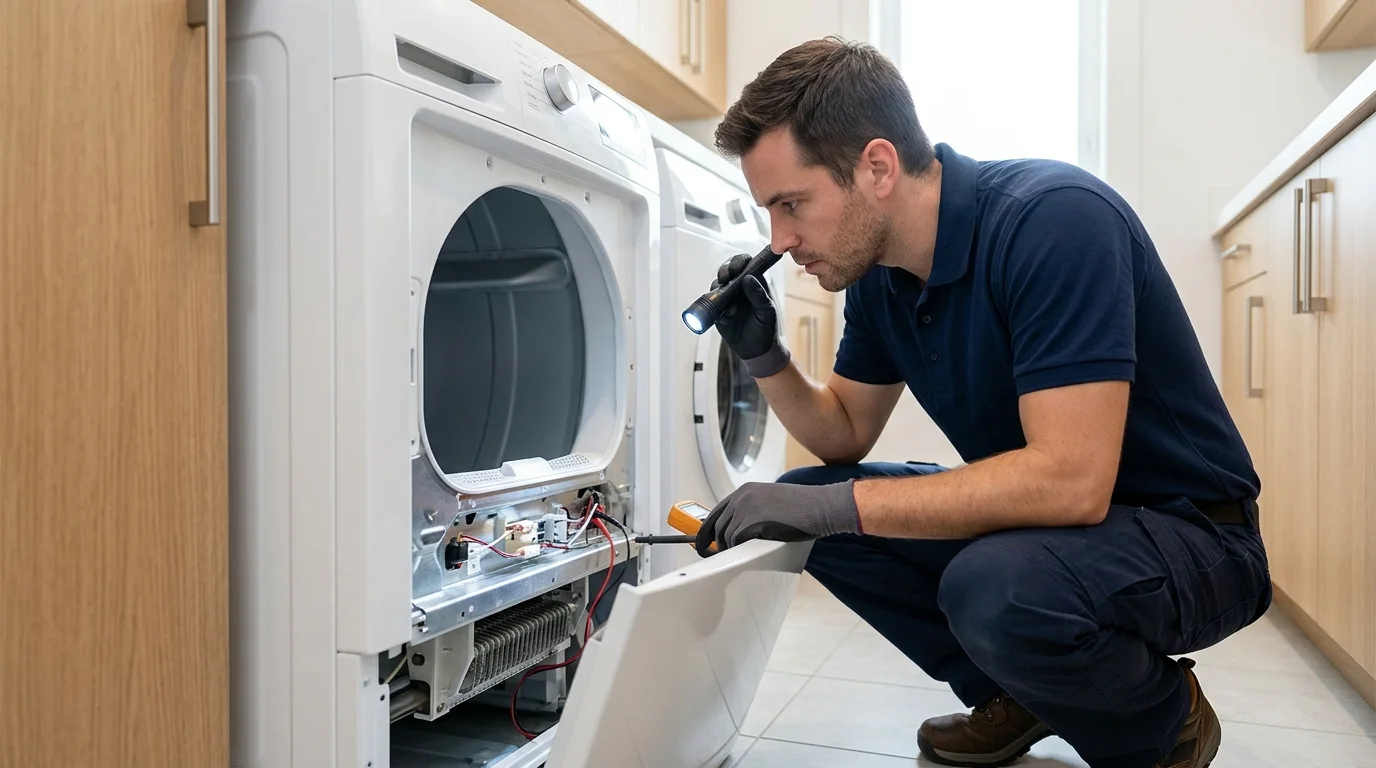
If the exterior airflow is weak and the accessible duct is clear, the restriction may be farther inside the home vent. That is a vent-system problem to address, not a reason to keep running longer and hotter cycles.
What a Technician May Inspect or Test
A technician can start by confirming heat output and airflow under controlled conditions. If the dryer is hot but exhaust is weak, the diagnostic emphasis stays on the airflow path. If airflow is good but heat is weak, the heating system moves to the front of the list.
On an electric dryer, testing may involve the supply, heating element, thermal protection devices, thermostats, temperature sensors, wiring, and control outputs. On a gas dryer, gas-side diagnosis and repair in Ontario must be handled within the applicable TSSA requirements by properly authorized personnel.
The technician may also inspect the blower system, internal lint accumulation, drum sealing, and moisture-sensor operation. A blower that is damaged or obstructed can reduce airflow even when the house vent itself is clear.
The goal is to identify which part of the drying process is failing: heat generation, air movement, moisture sensing, or the external vent system. That system-level answer is more useful than starting with the most familiar replacement part.
Why Restricted Airflow Can Look Like a Heating Fault
Restricted airflow changes the temperature pattern inside the dryer. Heat can build up near the heater or burner area because it is not being carried through the drum and out of the house efficiently. Protective controls may then reduce or interrupt heat. From the user’s point of view, the dryer may seem to heat strongly at first, cool off later, and still leave clothing damp.
That is one reason it is risky to diagnose a thermostat or heating element only from the fact that heat seems inconsistent. The airflow problem may be causing the heating system to cycle abnormally, not the other way around. A technician should therefore consider both systems together when long dry times and unusual temperature behaviour appear in the same complaint.
What to Record Before a Dryer Service Visit
A few observations before the service visit can give the technician a useful head start. Note whether the clothing is hot, warm, or cool when the cycle ends. Check whether the exterior vent flap opens and whether airflow feels strong or weak from a safe position outside. Record whether the problem affects every load or mostly towels, bedding, and heavy fabrics.
If the dryer has a displayed airflow warning or error code, record the exact code rather than clearing it from memory. Also note whether the dryer is gas or electric, whether the vent route was recently changed, and whether the problem began after the appliance was moved or pushed closer to the wall.
These details help separate a house-vent issue from an appliance heating or sensing issue. They also reduce the chance of a repair visit focusing on the wrong system first.
Long Dry Times Can Have More Than One Cause
It is possible for two small problems to combine into one major performance complaint. A slightly restricted vent may be tolerable with small loads but become obvious with towels. A moisture sensor with residue may end a cycle at the wrong time while a crushed duct is already slowing moisture removal. A weak heating system can also coexist with poor airflow.
That is why the correct repair is not always one component. The complete drying process should be checked before deciding that the first abnormal item found is the whole explanation.
Repair or Replace: Keep the Decision Tied to the Diagnosis
A slow-drying complaint does not automatically make an older dryer a replacement candidate. A vent restriction, cycle issue, or maintenance problem may be resolved without a major appliance repair. Even when a component has failed, the value of repair depends on the specific part, the dryer’s overall condition, and the actual estimate.
Replacement becomes a more reasonable option when the confirmed repair is substantial and the appliance also has other age-related issues, repeated faults, drum or bearing problems, control problems, or significant corrosion. Avoid applying a fixed age cutoff or a universal percentage rule before the diagnosis is known.
When to Request Appliance Repair
If the dryer still takes too long after you have cleaned the lint filter, reduced the load, confirmed a heated cycle, and checked the accessible vent path, a professional assessment is the next useful step. The same applies if there is little or no heat, recurring overheating, an error code, abnormal noise, or a safety warning.
For more service context, visit dryer repair Toronto. If you want the appliance assessed, Request Appliance Repair. A clear description such as “clothes are hot but damp and outside airflow is weak” is more useful to a technician than simply saying the dryer is slow.
Need Appliance Repair?
Share the appliance, brand, address, symptoms and optional photos online. A contractor can review the request and contact you about availability and next steps.
Start Your Repair Request