
Dryer Squealing, Thumping or Grinding: Noise Guide
Dryer Making Loud Noise guide: learn the key details, compare options, check verified sources, and make a safer decision before you act.

When a dryer is making loud noise, the type of sound tells you more than how loud it is. Squealing, thumping, rattling, and grinding each point the inspection in different directions. The same sound can still come from something in the load, an unlevel installation, or a worn internal component. The noise alone does not identify a failed part.
Start with three questions: Does the noise happen with the dryer empty? Does it repeat once per drum rotation? Does the sound change when the load changes? Those observations quickly separate many load and installation noises from internal rotating-component problems.
Dryer Making Loud Noise: Classify the Sound Before the Parts
Squealing or screeching often points toward friction in a rotating support or belt path, but the sound can also be affected by lint buildup or installation. Thumping that follows drum rotation may come from the load, drum support, a roller, or a flat spot that changes as the dryer warms. Rattling may come from coins, zippers, a vent connection, loose objects, or an unlevel installation. Grinding or scraping deserves more caution because it can indicate sustained contact between moving parts.
Whirlpool’s current dryer squealing guidance notes that internal lint buildup can contribute to squealing around belts and pulleys and that cleaning inside the cabinet may require service. That is a useful safety boundary: owner cleaning at the lint screen and accessible vent is different from opening the dryer cabinet.
Run the Empty-Dryer Comparison
If it is safe to operate the dryer briefly and there is no burning smell, electrical problem, or severe grinding, remove the load and listen. A noise that disappears when the drum is empty makes load contents and load distribution more likely. Check pockets for coins, keys, clips, bra hardware, zippers, or other hard objects before the next cycle.
A noise that remains with the dryer empty shifts attention toward the appliance or installation. Listen for whether it repeats at a steady rhythm. Do not run the dryer for a long period just to reproduce a damaging noise.
Once-Per-Rotation Noise Is a Valuable Clue
Mark the rhythm in your head. If a thump, scrape, or rub repeats each time the drum turns, something tied to drum rotation is more likely than a random cabinet rattle. The source can still be the drum surface, a seam, a support roller, a felt or glide area, a trapped object, or another rotating contact point.
If the rhythm speeds up or slows down with drum speed, record that detail. If the sound is constant rather than rhythmic, the motor, blower, airflow path, or a continuous friction point may deserve more attention.
Separate Load Noise From Dryer Noise
Before assuming a mechanical failure, look at the load. Shoes, belt buckles, coins, keys, large buttons, zipper pulls, and metal hardware can create surprisingly harsh sounds inside a steel drum. A heavy item can also fall at the same point each rotation and imitate a damaged roller.
If the noise disappears when the drum is empty, inspect the removed load carefully. Then try a normal soft load if it is safe to continue. A dryer that is quiet empty but noisy only with one specific item may not need internal repair.
If the sound remains empty, the appliance or installation becomes more likely. That is the point where rhythm, temperature, and location become more valuable clues.
Does the Noise Change as the Dryer Warms?
Some noises are strongest at startup and fade as components warm. Others appear only after several minutes. Record that timing. A thump that decreases after a few minutes can follow a different path from a squeal that begins only after the dryer is hot.
Do not keep running a dryer with a severe grind or burn smell just to see whether it changes. Timing observations are useful only when the appliance can be operated safely.
Location Helps, but Cabinet Sound Can Travel
Stand at a normal safe distance and listen from the front, side, and rear without touching moving parts. A noise that seems to come from the rear may involve the blower, motor, drum support, or simply a vent touching the cabinet. A front scrape may involve a glide, felt, object, or drum edge.
Sound travels through sheet metal, so do not overvalue location. Treat it as one axis alongside rhythm and load dependence.
Vent and Installation Noise Can Mimic Internal Failure
A rigid or semi-rigid vent can tap against the wall or cabinet as the dryer vibrates. An unlevel appliance can rock during tumbling. A loose object on top of the dryer can buzz or rattle. These are worth checking because they are external and safe to correct.
Make sure the dryer has stable contact on all feet and is not pushed against a wall, washer, shelf, or object that resonates. Do not crush or sharply bend the exhaust vent while repositioning the appliance.
Why Lint Buildup Changes the Safety Conversation
Lint is not only an airflow concern. Whirlpool notes that internal lint buildup can contribute to squealing or squeaking around the belt and pulley area. Internal cleaning that requires panel removal should be handled as service work rather than an owner step.
If the dryer also takes much longer to dry, runs unusually hot, or produces a burning odour, stop treating the complaint as “just noise.” Airflow restriction and overheating need to be considered, and continued operation may not be appropriate.
Grinding, Scraping, and Squealing Are Not Interchangeable
A squeal is usually a high-frequency friction sound. Scraping suggests a surface is rubbing another surface. Grinding often sounds rougher and more forceful, as if rotating components are not moving freely. People describe sounds differently, so a recording can be useful.
Instead of trying to identify the exact part from the adjective, combine the sound with timing. “Squeals only when hot,” “scrapes once per rotation,” or “grinds immediately even when empty” are stronger diagnostic descriptions.
What Different Dryer Noises Can Suggest
Squealing or high-pitched screeching
Squealing often comes from friction in a rotating support or belt system. LG’s current dryer noise guidance identifies worn rollers, belt-related parts, and drum-support conditions as possible sources of squealing or scraping sounds. That is a cause group, not a diagnosis. A technician still needs to locate the sound and inspect the moving system.
Rhythmic thumping
A heavy item such as shoes can create an obvious thump. So can a drum-support condition. If the sound is present only with one type of load, test a normal soft load after checking pockets. If the thump continues empty and repeats with drum rotation, service is more sensible than repeated use.
Rattling or knocking
Check that the dryer is stable and level. Whirlpool’s current knocking and rattling guidance notes that an unlevel dryer or missing leg can contribute to knocking. Also look for an accessible vent duct or object touching the cabinet.
Scraping or rubbing
A light temporary rub after moving the appliance can come from external contact, but a persistent internal scraping sound should not be ignored. Check for an object trapped at an accessible drum edge only if it is visible without reaching into moving or energized areas. Do not remove panels to hunt for it.
Grinding
Grinding is the strongest stop-use signal. If the drum struggles to turn, the sound worsens over a cycle, or it combines with a burning smell or electrical symptom, stop the dryer. Continued operation turns a repairable wear problem into a more costly one.
Safe Checks a Homeowner Can Make
Empty pockets and remove obvious hard items from the drum. Check that the dryer sits firmly on all feet and does not rock. Make sure the vent connection is not striking the cabinet. Clean the lint screen and inspect the accessible vent path for an obvious obstruction without dismantling the dryer.
With the dryer off, look inside the drum for a visible loose object. Do not reach into gaps, remove the drum, or open the cabinet. If the dryer is unplugged and the owner manual permits rotating the drum by hand, you may note whether a rough spot or repeating scrape can be felt, but do not force the drum.
Record whether the noise happens at startup, throughout the cycle, only when hot, only with a heavy load, or once per rotation. That timing can be more useful than describing the volume.
When to Stop Using the Dryer
Stop using the dryer if the noise is severe grinding or metal scraping, the drum is visibly unstable, the dryer shakes or moves unexpectedly, there is a burning smell, smoke, sparking, repeated breaker tripping, or the drum stops turning normally. Those signs move the problem beyond routine noise observation.
If a gas dryer also has a gas odour, treat that as a separate gas-safety issue rather than a mechanical noise diagnosis. This article does not provide gas-system troubleshooting.
What the Sound Does Not Prove
A squeal does not prove a bad idler. A thump does not prove a roller. A grind does not prove the motor. These are possibilities that need physical inspection and sometimes component testing.
Sound travels through the cabinet and floor, so the place where the noise seems loudest can be misleading. A technician may need to run the dryer with panels in a service-safe configuration and inspect the entire rotating path.
What a Technician May Inspect
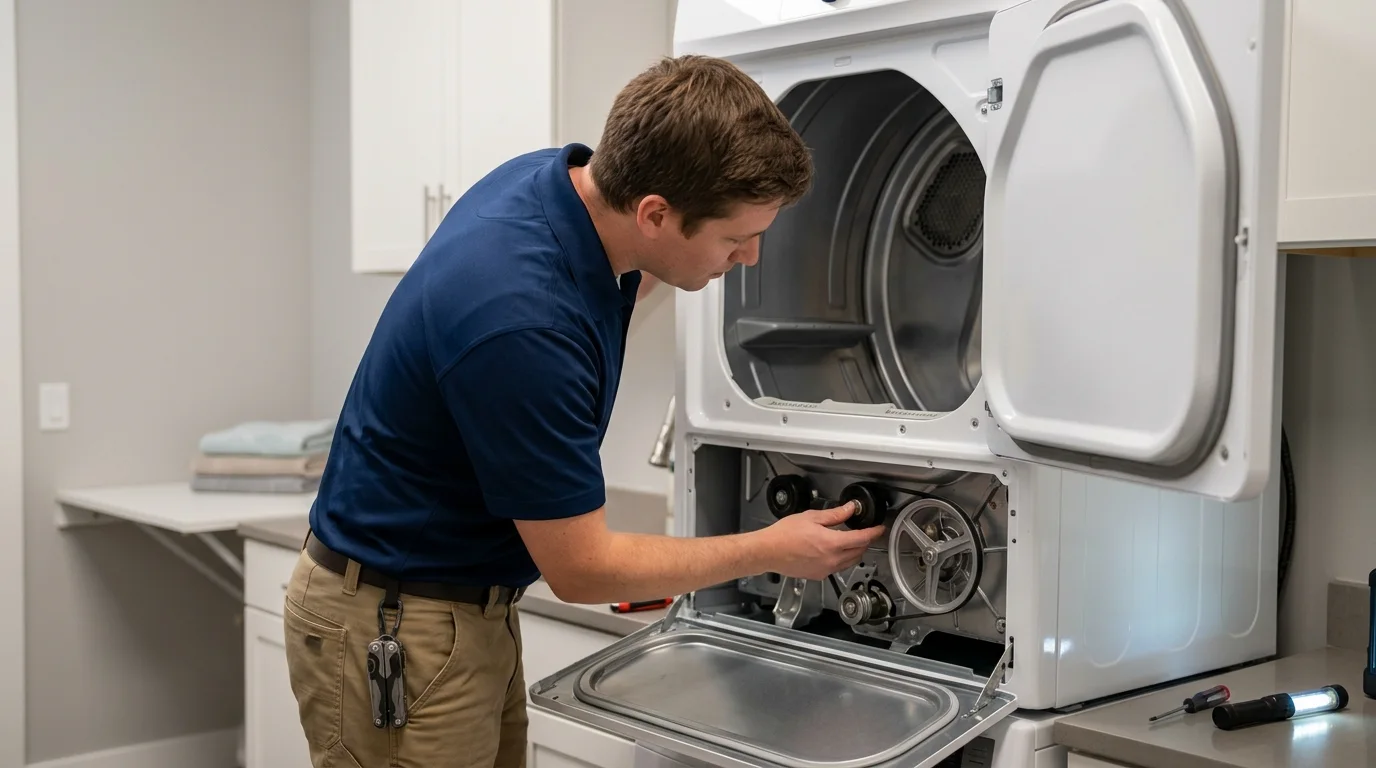
A professional can inspect the drum supports, rollers, glides, belt condition, idler assembly, motor and blower area, drum seals, cabinet contact points, and signs of trapped objects or internal lint buildup. The exact components depend on the dryer design.
The technician can also reproduce the sound empty and with an appropriate test load, then compare whether the noise changes as the dryer warms. Some support components become noisier only after heating, while load-related sounds disappear when the drum is empty.
Why a Small Noise Change Can Be Worth Recording Early
Mechanical wear often becomes easier to identify when the first consistent pattern is documented. A faint squeal that appears only after warm-up can later become constant. A light rhythmic thump can become louder as a support surface wears. Recording the early pattern gives a technician a comparison point if the symptom develops.
That does not mean every new sound requires immediate parts replacement. The goal is to notice whether the sound is stable, worsening, load-dependent, or paired with another symptom such as slow drying, overheating, drum hesitation, or burning odour.
If a noise is mild and the dryer is otherwise operating normally, safe external checks may be reasonable. If the sound changes rapidly, becomes grinding or scraping, or affects drum movement, stop using the dryer and request assessment rather than waiting for a more obvious failure.
When to Request Appliance Repair
Request professional assessment when the noise continues with the dryer empty, repeats every rotation, grows worse, is accompanied by poor drum movement, or returns after levelling and load checks. A new persistent squeal can be addressed before it becomes a more damaging failure. Severe grinding, scraping, burning odour, or electrical symptoms should be treated more urgently.
For related service information, see dryer repair Toronto. To send the model, sound description, timing, and whether the noise occurs empty or only with a load, Request Appliance Repair.
Record the Noise in a Way That Helps Diagnosis
A short video or audio recording from a safe distance can help if the noise is intermittent. Record the first few seconds of startup and a period of steady tumbling. Note whether the drum is empty or loaded and whether the dryer is cold or already warm.
Use ordinary words. “One thump every drum turn” is more useful than “terrible noise.” “High squeal only after ten minutes” gives timing. “Grinding starts immediately even when empty” gives a strong stop-use clue. Good symptom notes help the repair process without pretending to identify the part.
Also note whether drying performance changed when the noise began. A dryer that suddenly becomes noisy and takes longer to dry may have more than one symptom worth investigating. The combination can shift attention toward airflow, drum movement, or internal mechanical drag instead of treating the sound as an isolated annoyance.
That extra context can also help distinguish a cosmetic rattle from a developing mechanical condition that deserves timely inspection.
Dryer Making Loud Noise: Practical Takeaway
Diagnose dryer noise by type, rhythm, and load dependence. Empty pockets, check levelling, and inspect the accessible vent connection first. If the sound persists with an empty drum, repeats once per rotation, or turns into grinding or scraping, the drive system needs a professional look. Stop running the dryer if the noise worsens, the drum hesitates, or there is any burning smell.
Need Appliance Repair?
Share the appliance, brand, address, symptoms and optional photos online. A contractor can review the request and contact you about availability and next steps.
Start Your Repair Request