
Dryer Drum Not Turning: Belt, Motor and Roller Clues
Dryer Drum Not Spinning guide: learn the key details, compare options, check verified sources, and make a safer decision before you act.
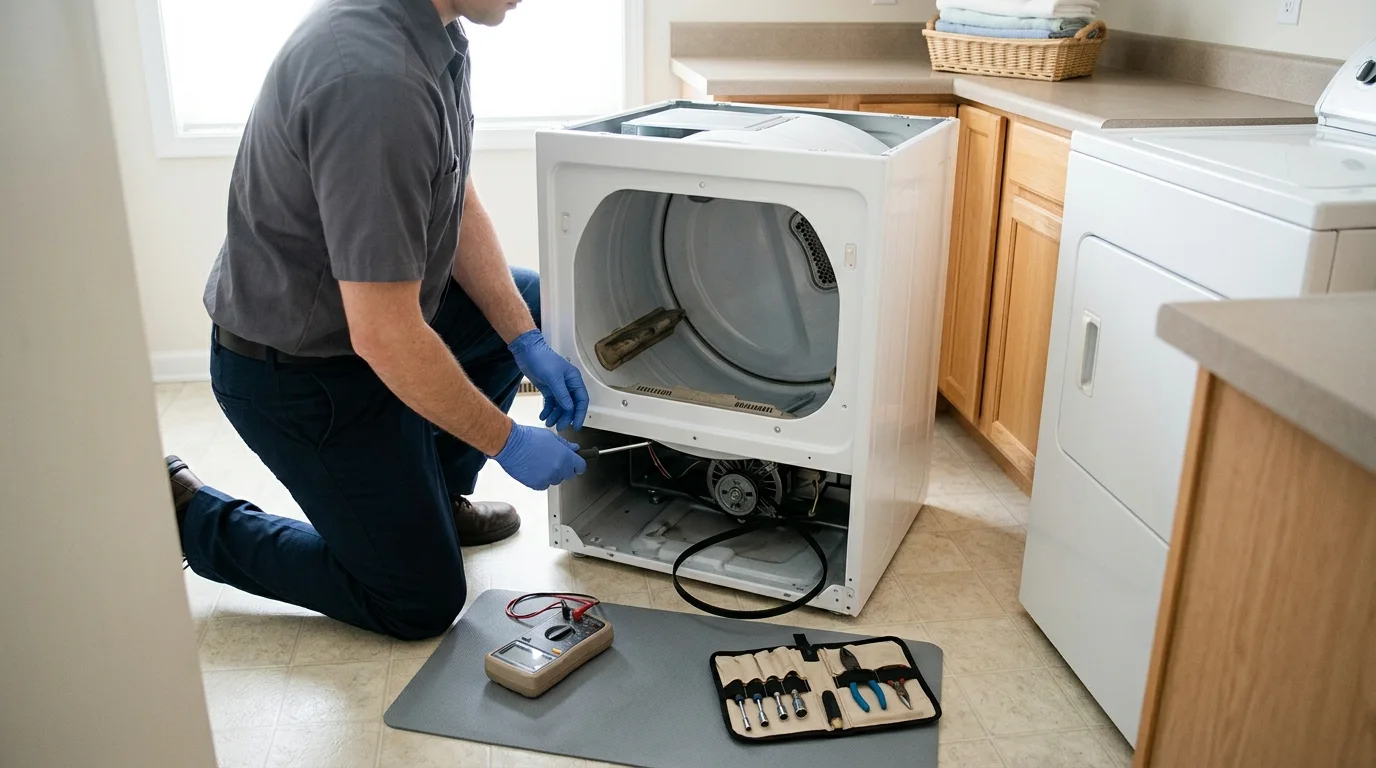
When a dryer powers on but the drum won’t spin, the belt is a common suspect, but it is not the only possibility. The cause can be anywhere in the start-and-drive chain: door interlock, cycle controls, belt, idler, drum supports, motor, or a drum that is binding. The most useful diagnostic clue is what the dryer does the moment you press Start.
Listen before you touch anything. A quiet dryer, a motor hum with no drum movement, or a dryer that starts and immediately stops are different symptoms. Those patterns help narrow the problem without opening the cabinet or guessing at a part.
Dryer Drum Not Spinning: Start With What You Hear
Complete silence when Start is pressed shifts attention toward power, controls, or the door-switch circuit before the drive system. A motor hum with no drum movement shifts attention to the belt, drum supports, or a seized rotating component. A drum that starts briefly and then stops may involve motor protection, heat, or mechanical resistance. Each sound leads to a different diagnostic branch.
Whirlpool’s current dryer not spinning guidance lists power, door closure, control lock, a broken belt, motor problems, and a seized drum among possible causes. That range is exactly why a stationary drum should be treated as a symptom, not a one-part diagnosis.
First Separate a No-Start Problem From a No-Spin Problem
Look at the control panel. Does it light normally? Does the dryer acknowledge the Start command? Does the interior light change when the door closes? Can you hear a relay click, motor hum, or fan sound? These observations help establish whether the machine is attempting to run.
If the dryer has no power at all, the troubleshooting path is different from a machine that powers up normally but cannot rotate the drum. Check the wall power, breaker, plug, door closure, and control lock according to the owner manual before treating the complaint as a belt or motor issue.
If an electric dryer has a damaged plug, scorched outlet, loose connection, repeated breaker trip, or visible heat damage, stop there. Do not keep resetting the breaker to force another test.
A Motor Hum With a Still Drum Is an Important Clue
A low hum after Start means the dryer is at least trying to energize something, but it does not prove the motor itself has failed. A drum can resist movement because of a seized roller, damaged bearing or support, a jammed blower, a belt or idler problem, or another obstruction in the rotating system. A motor under excessive load can also hum without getting the drum moving.
Do not leave a humming dryer energized while the drum is stationary. A stalled motor can generate heat. Stop the cycle and move to a professional assessment if the symptom repeats.
Does the Drum Feel Abnormally Loose or Hard to Turn?
With the dryer off and unplugged, some owner manuals allow the drum to be rotated by hand. If yours does, use only gentle pressure. You are not trying to diagnose the exact part. You are noting whether the drum feels roughly normal, unusually free, or unusually difficult to move.
An unusually light, free-spinning feel can be consistent with a belt no longer providing normal resistance, but it is not proof of a broken belt. A drum that is difficult to move or catches at one point can suggest mechanical drag from supports, an object, or another rotating component.
If the drum will not move with gentle pressure, do not force it. Forcing a bound drum can create more damage and does not provide useful additional evidence.
What a Broken Belt Can Look Like
The drive belt transfers motor rotation to the drum. If it breaks or comes off its path, the motor may still be capable of running while the drum does not turn. Some dryers also use belt-related safety switching that can prevent continued operation when belt tension is lost.
A belt failure can therefore present differently across models. One dryer may sound like it is running without drum movement. Another may not continue running. That model variation is a reason not to diagnose the belt from sound alone.
Motor Trouble Usually Comes With More Than One Clue
A failing motor may hum, struggle to start, stop after heating up, restart after cooling, or produce an unusual electrical or mechanical sound. But those same patterns can overlap with mechanical drag, airflow problems, or supply issues.
Whirlpool also includes a broken motor among possible causes of a dryer that will not spin, while its broader dryer troubleshooting guidance notes that internal drive repairs generally require cabinet access. Motor diagnosis belongs after the easier external conditions have been checked.
Rollers, Bearings, and Supports Can Stop a Healthy Motor From Moving the Drum
Dryer drums ride on a support system that varies by design. Rollers, shafts, bearings, glides, felt seals, and related supports keep the drum aligned while it turns. Wear or damage can increase drag enough that the motor struggles, the belt slips, or the drum stops moving normally.
Noise history matters here. If the dryer was squealing, thumping, scraping, or grinding before the drum stopped, tell the technician. A recent change in mechanical noise can connect the no-spin symptom to the rotating support system more clearly than the current silence does.
Load Size Can Expose a Marginal Drive Problem
Notice whether the dryer fails only with a heavy load or also when empty. A weak or binding drive system may appear to work with a light load and struggle with towels, bedding, or other heavy items. An overloaded drum can also prevent normal tumbling even when no part is broken.
Do not repeatedly test with heavier loads to see what happens. One brief comparison with an empty drum, only if the dryer operates safely, is enough to tell you whether load demand changes the symptom.
Safe Checks Before You Assume an Internal Failure
Make sure the dryer is properly powered, the door closes firmly, the control lock is off, and the selected cycle can start. Remove the load and look for an obvious article trapped at the drum edge. Clean the lint screen. Check that the dryer is stable and not pressed against something that interferes with movement.
If the dryer is unplugged, inspect the accessible drum opening for a visible foreign object. Do not reach behind the drum, remove panels, bypass a door switch, or try to hold a switch closed while the dryer runs.
Record exactly what happens when Start is pressed: silence, click, hum, airflow sound, brief movement, or full operation without drum rotation. That description is far more useful than saying only that the dryer is broken.
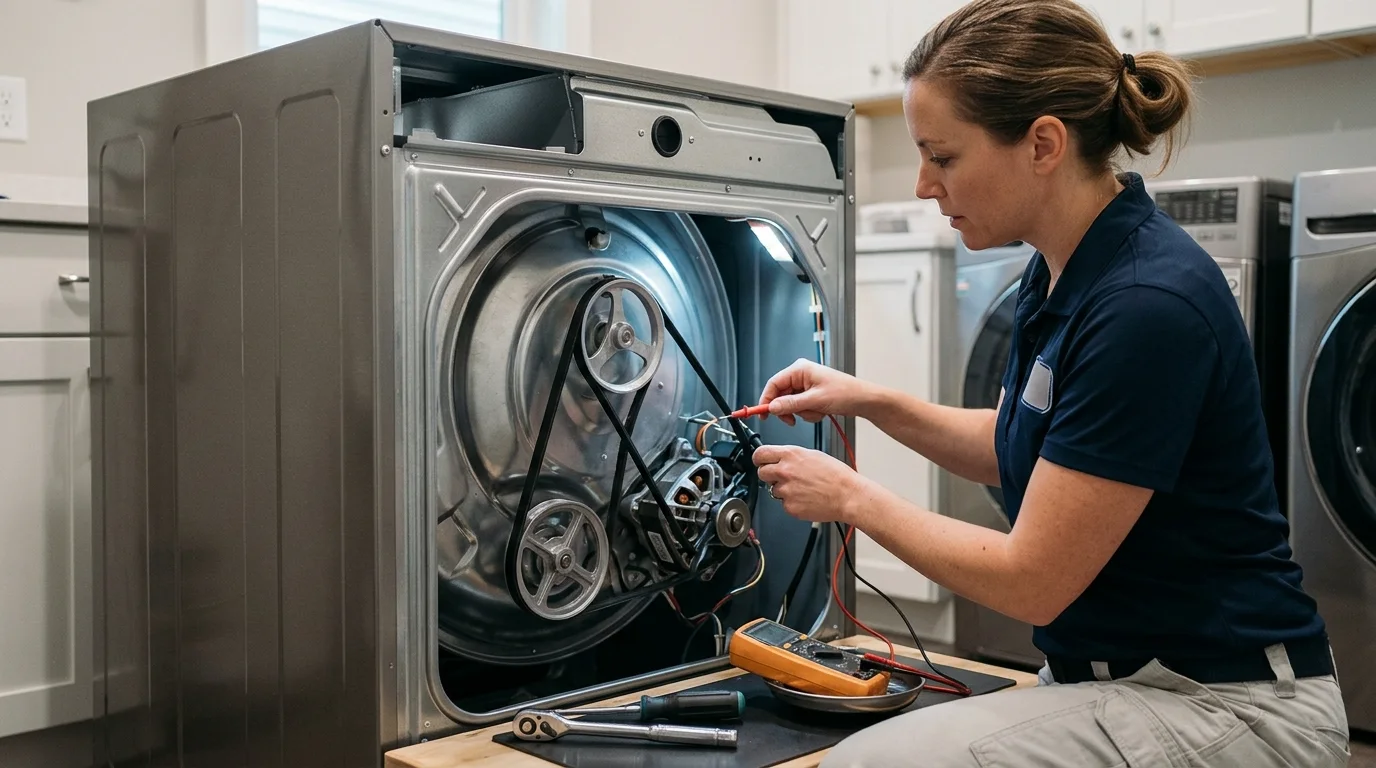
Use the Start Sound as a Simple Decision Tree
Silence with a normal display: focus on door closure, Start input, cycle settings, interlocks, and control permission before the drive system. Click but no hum: the control is attempting a transition, but the motor may not be receiving or using that command. Hum with no drum movement: mechanical resistance, motor starting, belt path, or blower resistance become more important. Motor or airflow sound with a still drum: lost drive between the motor and drum becomes more plausible.
This sound-based approach is useful because it follows the machine’s sequence instead of jumping to a parts list. The exact sound is still not a diagnosis, but it tells a technician which branch to test first.
If the Dryer Still Produces Heat but the Drum Does Not Move
A dryer that heats while the drum remains stationary needs to be stopped. Clothes are designed to tumble through moving air, and stationary fabric near a heat source is not a condition to keep testing. The combination also suggests that at least part of the heating system is operating while the drive system is not.
Do not run a heated no-spin dryer to see whether the drum eventually starts. The useful observation is already complete: the heat and drive systems are behaving differently.
Why Prior Noise History Matters
Think back to the days or weeks before the drum stopped. A new squeal can suggest rising friction in a support or idler. A repeated thump can point toward a rotating support or load interaction. A grinding sound can suggest a component was no longer moving freely. A dryer that became slower to start with heavy loads may have been showing increasing drive resistance.
That history can reveal a progression. A belt that finally breaks may have been stressed by another worn component. A motor that now hums may have been working against abnormal drag. Service should look for the cause chain, not just the final failed item.
Do Not Try to “Help” the Drum Start
Some online videos suggest holding the door switch and pushing the drum by hand. Do not do this. It defeats a safety interlock, puts hands near moving components, and produces unreliable diagnostic information. Multiple faults can respond temporarily to added momentum without revealing the actual cause.
If a technician needs to determine motor starting torque or drum resistance, that can be done with the cabinet safely serviced and the correct procedure for the model.
What to Record Before Service
Write down five details: whether the panel powers normally, the exact sound when Start is pressed, whether the drum moves even briefly, whether the dryer had unusual noise before the failure, and whether the problem changes with an empty drum. If there is an error code, record it exactly rather than clearing it repeatedly.
A short video of the sound and panel, taken from a safe distance without opening or bypassing anything, can also help. The goal is to capture behaviour, not to prove a part.
What a Technician May Inspect or Test
Once external conditions are ruled out, a technician can inspect the drive system directly. That may include the belt path and tension, idler or tensioner, drum rollers or supports, motor shaft and pulley, blower movement, door and belt switches where used, and whether the drum has abnormal resistance.
The diagnostic order matters. A motor should not be condemned simply because it hums. If the drum or blower is mechanically bound, a healthy motor can sound weak because it is being asked to start against too much resistance.
Electrical testing may also be needed to confirm that the motor is receiving the correct command and supply. Those checks should be performed with proper procedures and equipment rather than by bypassing interlocks.
When the Belt Is Not the Whole Repair
Sometimes a broken belt is the visible failure but not the original cause. A seized roller, damaged idler, hard-turning drum, or another binding component can overload the belt. Replacing only the belt without checking why it failed can lead to another breakdown.
This is one reason a professional assessment should include the whole drive path, especially if there was squealing, grinding, or difficult drum movement before the dryer stopped spinning.
When to Stop Using the Dryer
Stop using the dryer if the motor only hums and cannot start the drum, the drum is jammed, there is grinding or metal scraping, a burning odour appears, the plug or outlet is hot or damaged, the breaker repeatedly trips, or smoke or sparking is present. Continued testing is not useful in those conditions.
If the appliance is a gas dryer and you smell gas, treat that as a separate fuel-safety issue. Follow Enbridge Gas suspected-leak safety guidance and do not continue appliance troubleshooting in the area.
What the Symptom Does Not Prove
A still drum does not prove a broken belt. A humming motor does not prove a bad motor. An easy-turning drum does not prove the belt is broken. A difficult drum does not prove a roller has failed. Each clue changes the probability of different cause groups, but the internal system still needs inspection before a part is named with confidence.
The best homeowner contribution is a clean symptom history: whether the controls work, what sound occurs at Start, whether the drum moved at all, whether the problem changed with load size, and whether noise or overheating appeared before the failure.
Repair or Replacement?
A no-spin problem is not automatically a reason to replace the dryer. Belt, idler, support, switch, or other drive-related repairs can be very different in scope from a motor or multiple-component failure. Age, overall condition, prior repair history, parts availability, and the confirmed fault all matter.
If the dryer has repeated major problems or the diagnosis shows several worn systems at once, compare the confirmed repair scope with replacement rather than deciding from the symptom alone.
When to Request Dryer Repair
If the dryer has power but the drum still will not turn after the safe checks above, or if it hums, binds, scrapes, or stops under load, a professional diagnosis is the sensible next step. The dryer repair service page explains the broader service category without changing this article into a commercial landing page.
When submitting a service request, include whether the dryer is electric or gas, whether the panel powers up, what you hear when Start is pressed, and whether the drum can move gently when the appliance is unplugged. Those details help narrow the inspection before a part is assumed.
Request Appliance Repair if the dryer drum remains stationary or the drive system shows signs of binding, overheating, or repeated start failure.
Need Appliance Repair?
Share the appliance, brand, address, symptoms and optional photos online. A contractor can review the request and contact you about availability and next steps.
Start Your Repair Request