
Dryer Burning Smell: When to Stop and What It Can Mean
Dryer Smells Like Burning guide: learn the key details, compare options, check verified sources, and make a safer decision before you act.
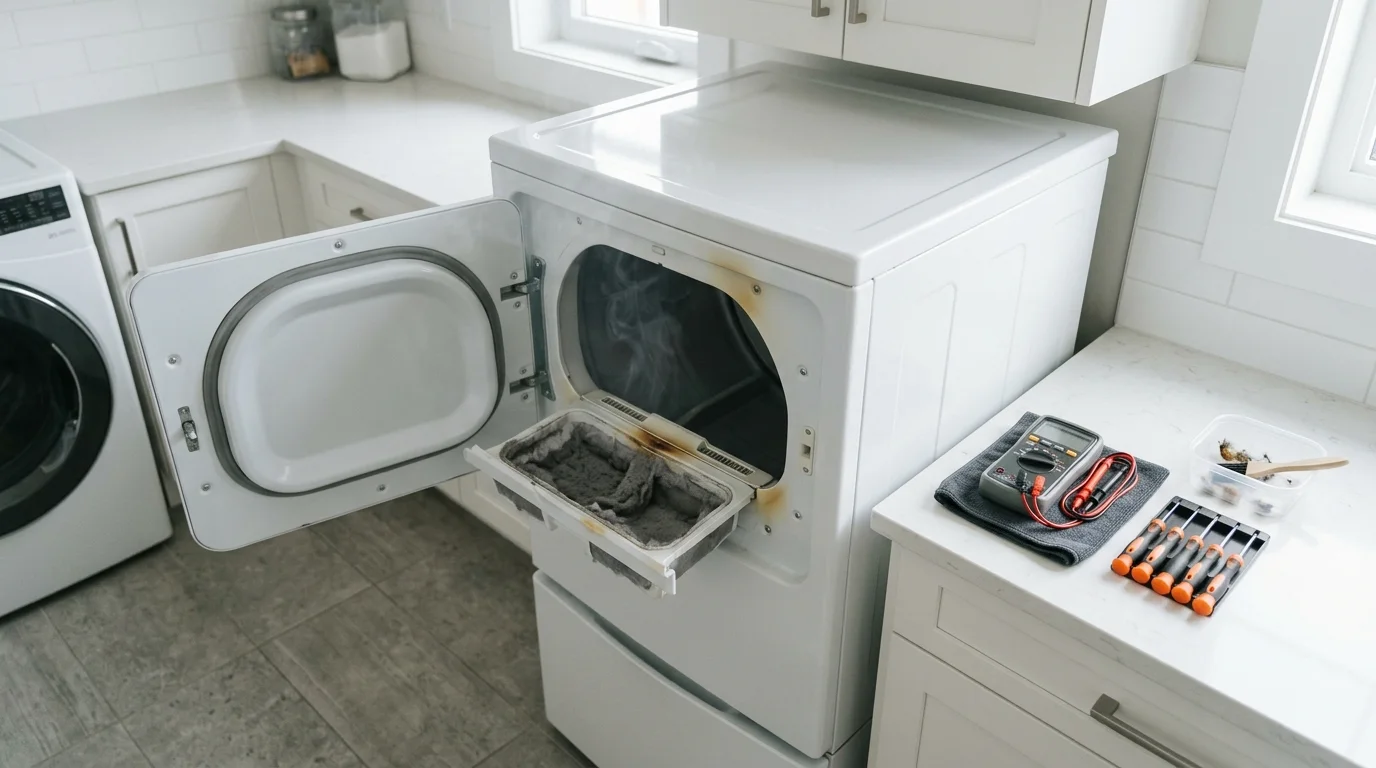
If your dryer smells like burning and the smell is new, stop the cycle first. If there is smoke, visible scorching, sparking, extreme heat, or a strong electrical smell, disconnect power if you can do so safely and do not run another test cycle. A burning smell can come from lint restriction, friction, a motor or belt problem, wiring, or a foreign item, and the smell alone cannot identify the failed part.
Dryer Smells Like Burning: What to Do in the First Minute
Turn the dryer off. Do not keep the drum running just to decide whether the smell is getting better or worse.
If you see smoke or fire, leave the area and use emergency services rather than continuing appliance troubleshooting. If there is no visible fire but the dryer is unusually hot or the smell is strong and electrical, disconnect it from power if the plug or breaker can be reached safely. Do not touch a damaged plug, hot cord, or scorched outlet.
For a related next step, read dryer repair Toronto.
Whirlpool’s current overheating guidance says to check airflow, the lint trap, and exhaust vents and to call a professional if there is a burning smell coming from the dryer. The U.S. Fire Administration also identifies failure to clean as a leading factor in clothes-dryer fires. That makes a new burning odour a stop-and-investigate symptom, not something to mask with fragrance or another hot cycle.
Before You Check Anything, Let the Dryer Cool
Once the appliance is off, give hot surfaces time to cool. Keep children and pets away. If the plug, receptacle, cord, wall area, or cabinet shows visible heat damage, do not reconnect the dryer until the electrical and appliance condition has been assessed.
Only after there is no active smoke, fire, sparking, or dangerously hot surface should you make basic external observations. The useful questions are where the smell seems strongest, whether the dryer had been running hotter or longer than usual, and whether there was any recent change in the load, vent, installation, or appliance sound.
The Smell Is Evidence, Not a Parts Test
People describe burning odours differently. One person may call hot lint “dusty,” another may call it “scorched,” and another may interpret hot rubber as electrical. Treat the description as a clue, not a diagnosis.
A hot, dusty, or scorched-lint smell makes airflow restriction and lint accumulation important to check. A rubber-like smell can be associated with friction from a belt or another moving part, but it can also come from an item that does not belong in the dryer. A sharp electrical smell raises concern about wiring, connections, controls, or a motor. A melted-plastic smell can come from a foreign object or heat-damaged component.
None of those descriptions proves the source. If the smell is persistent or strong enough to make you question whether the dryer is safe, leaving it off is the correct choice.
Lint and Restricted Airflow Are a Major Safety Branch
A dryer has to move large amounts of warm, moist air out of the drum and through the exhaust system. Lint that collects at the screen, inside the lint path, in the transition duct, or farther along the house vent can reduce that airflow.
Restricted airflow does two things at once. It slows moisture removal, so loads take longer to dry, and it can allow heat to build in places where the machine was designed to move it away. Protective controls may cycle heat off, but they are not a substitute for a clear airflow path.
The U.S. Fire Administration reports that failure to clean was the leading factor contributing to ignition in home clothes-dryer fires from 2018 through 2020. That does not mean every burning smell is lint, but it is strong reason to treat airflow as a safety check rather than just an efficiency issue.
Safe External Airflow Checks After Shutdown
- Remove and inspect the lint screen. A heavily loaded screen is an obvious restriction. Clean it according to the dryer instructions.
- Look behind the dryer. With the appliance off, inspect the visible transition duct for crushing, disconnection, melting, or a sharp kink.
- Check the exterior vent area. Look for a flap that is stuck, heavy visible lint, a nest, snow, or debris blocking the outlet.
- Notice recent performance. Longer dry times, unusually hot clothing, or a very hot laundry room strengthen the airflow-overheating concern.
- Look for lint around the appliance. Excess lint behind or below the dryer can indicate an exhaust or internal lint-path problem.
Do not remove energized electrical covers or reach into the blower, heater, burner, or motor area. If the restriction is inside the wall vent or the dryer itself, that becomes a professional cleaning or repair problem rather than a reason to keep running the machine.
Friction, Belt, Drum, and Motor Clues
A dryer drum carries a heavy load while turning on belts, rollers, bearings, pulleys, and a motor system. A component that starts dragging can create friction and heat. A slipping belt can produce a rubber-like odour. A failing roller or bearing can make scraping, squealing, or thumping sounds that appear before or alongside the smell.
A motor that is struggling mechanically or electrically can also become unusually hot. The key pattern is a new odour combined with a change in sound, drum speed, or the ability of the dryer to start and keep turning.
Do not test this by repeatedly restarting the dryer. Once a new burning smell has appeared on an established machine, repeated operation can add heat without giving you enough information to safely identify the cause.
Electrical Odour, Hot Plug, or Breaker Problems
An electrical burning smell deserves a stricter response than an ordinary hot-dust smell. Inspect only the visible power cord, plug, and receptacle area from a safe position after the dryer is off. Discolouration, melting, looseness, scorching, or abnormal heat are reasons to leave the appliance disconnected.
A breaker that trips repeatedly should not be reset over and over. The fault may be in the appliance, the branch circuit, the receptacle, or a connection. A technician and, where appropriate, a qualified electrical professional can determine which side of the installation is responsible.
Do not use an extension cord to keep the dryer running from another outlet. Major appliances should be connected using the installation requirements for the appliance and the home electrical system.
Could a Foreign Item Be Burning?
Sometimes the source is not a dryer component. A pen, plastic item, foam-backed article, rubber-coated piece, oily rag, or object left in a pocket can contact hot surfaces or create an unusual odour.
After the dryer is off and cool, inspect the drum and clothing for melted residue, dark marks, or a damaged item. Do not reach past the drum or lint-screen opening into internal spaces.
If a foreign object has clearly melted onto an accessible drum surface, follow the manufacturer’s cleaning guidance before the dryer is used again. If material has entered the lint path or heating area, professional inspection is safer than trying to retrieve it through openings.
A Brand-New Dryer Can Smell Different
Whirlpool notes that a new gas or electric dryer can produce a temporary semi-burning or oily smell during initial use. New components, coatings, or manufacturing residue can create an odour that is not the same as a sudden electrical or rubber burning smell on an established dryer.
That exception should be narrow. If a new dryer produces smoke, sparking, scorching, a hot electrical cord, a repeated breaker trip, or a strong smell that seems abnormal rather than a mild initial odour, stop and have the installation and appliance checked. Do not use the “new dryer smell” explanation to dismiss an active safety warning.
Common Mistakes to Avoid
Running another full load to see whether the smell returns. A new burning odour is already enough information to justify stopping and checking the cause.
Assuming lint is the only possibility. Airflow is important, but belts, motors, wiring, foreign objects, and electrical connections can produce overlapping odours.
Spraying fragrance or cleaner to cover the smell. Masking the odour removes a diagnostic clue and does nothing about overheating.
Resetting a tripped breaker repeatedly. Repeated trips are evidence of a fault, not an obstacle to bypass.
Removing panels while the dryer is connected to power. Internal electrical, motor, heater, and gas-side systems require appropriate training and model-specific procedures.
What a Technician May Inspect or Test
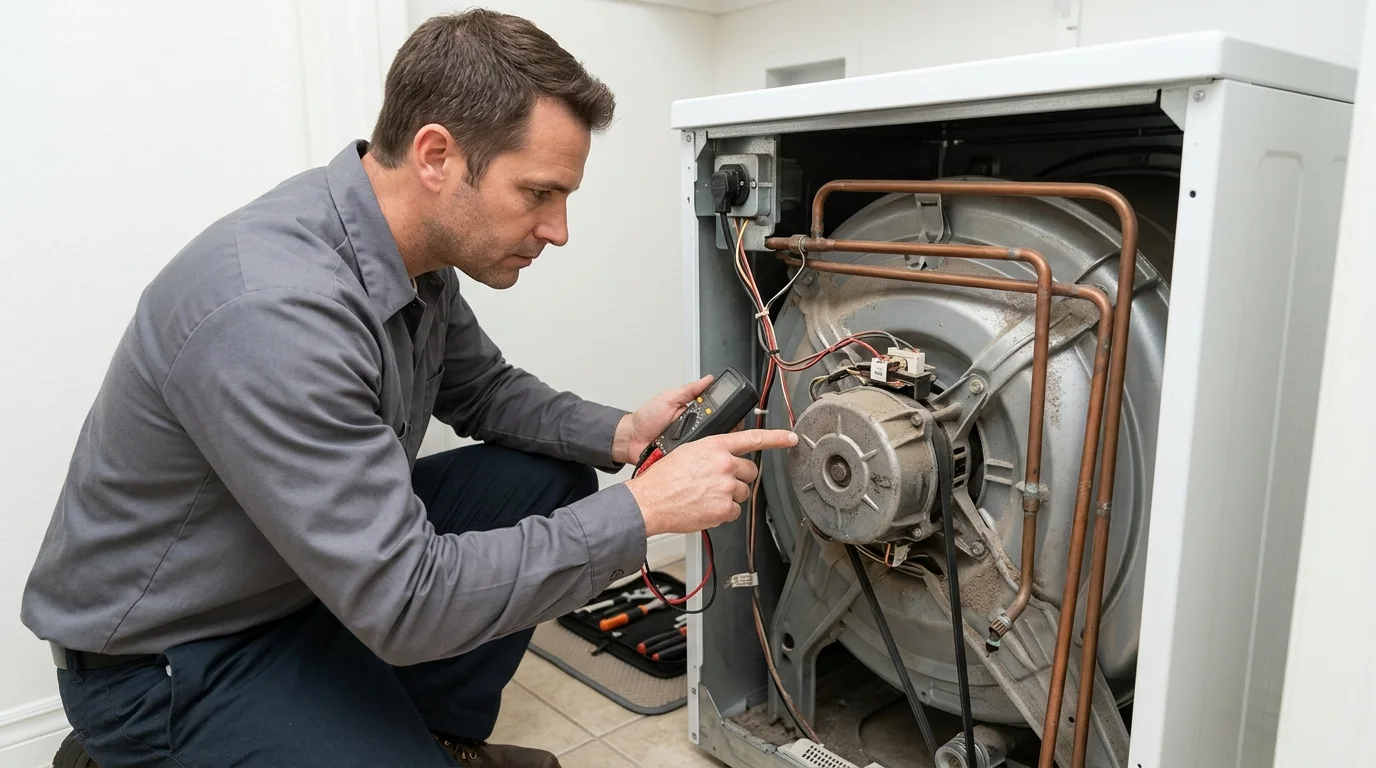
A technician can inspect the lint path and exhaust connection, check whether the blower is moving air normally, and look for heat damage or lint accumulation inside the cabinet. Drum supports, belt condition, pulleys, bearings, and motor operation can be evaluated for friction or overheating.
Electrical testing may include the power connection, wiring, terminals, heating circuit, thermal protection devices, motor circuit, and controls, depending on the dryer design. The goal is not merely to find the hottest-looking part. It is to determine why excess heat or burning odour appeared and whether another condition caused it.
On a gas dryer, gas-side diagnosis is a separate regulated and safety-sensitive area. A gas odour is not the same as a burning smell. If natural gas is suspected, follow the gas utility’s emergency guidance rather than using an online appliance request form.
If the Smell Disappears After an External Check
A clean lint screen or corrected crushed duct may remove an obvious restriction, but do not treat the disappearance of the smell as proof that every internal component is safe. If the original odour was strong, electrical, rubber-like, or accompanied by abnormal heat or sound, professional inspection is still the safer next step.
The goal of the external checks is to identify clear conditions without adding more heat to the appliance. They are not a requirement to restart a dryer that gave a genuine stop-use warning.
The House Vent and the Dryer Are Two Different Places to Check
A dryer can have a clean lint screen and still have restricted airflow farther downstream. The flexible transition duct behind the appliance can be crushed, the rigid duct inside the home can collect lint, and the exterior hood can be blocked or unable to open. Longer vent paths, multiple elbows, and shared building constraints can make the restriction less obvious from the laundry room.
That is different from lint or debris inside the dryer cabinet. A homeowner can inspect the lint screen, visible transition duct, and exterior termination after the appliance is shut down and cool. Internal lint accumulation near the heater, burner, motor, wiring, or blower requires cabinet access and should be handled as a service issue rather than a reason to keep testing a dryer that already produced a burning odour.
If outdoor airflow is weak even though the accessible transition duct is clear, the house vent itself may need professional cleaning or inspection. If outdoor airflow is strong but the burning odour returns, the evidence points back toward the appliance rather than proving that the vent is the only cause.
A Gas Odour Is a Different Emergency From a Burning Smell
If a gas dryer produces a rotten-egg or sulphur-like odour and you suspect natural gas, do not keep troubleshooting the appliance. Enbridge Gas Ontario says to leave the area immediately and call its emergency line or 911 from a safe location. Do not stay inside to find the leak or run another dryer cycle.
Gas-side diagnosis is also not a homeowner repair step. TSSA states that registered fuels contractors are the businesses legally authorized to perform fuels-related work in Ontario. A burning lint, rubber, motor, or electrical smell and a suspected natural-gas smell are different problems, but both are reasons to stop using the dryer until the correct safety issue has been identified.
Repair or Replace Only After the Safety Issue Is Identified
A lint restriction, worn belt, damaged cord connection, motor problem, or major heat-related electrical fault creates a very different repair decision. Do not continue using the dryer while trying to decide whether replacement is cheaper.
Once the cause is confirmed and the appliance is safe, compare the actual repair with the dryer’s overall condition and repair history. Avoid a fixed age rule. A targeted repair on an otherwise sound dryer is a different decision from an appliance with repeated overheating, control, drum-support, and electrical problems.
When to Request Appliance Repair
Leave the dryer off and request professional assessment if the burning smell returns or persists, if the cabinet or clothing becomes abnormally hot, if there are unusual motor or drum noises, if the vent path appears restricted beyond the accessible areas, or if there is any electrical heat damage.
If there is active smoke, fire, sparking, or a suspected gas leak, use the appropriate emergency response rather than waiting for appliance service. For a non-emergency dryer that is safely shut down and needs diagnosis, Request Appliance Repair and describe the smell, when it started, whether drying time changed, and whether you noticed unusual heat, sound, or breaker behaviour.
Need Appliance Repair?
Share the appliance, brand, address, symptoms and optional photos online. A contractor can review the request and contact you about availability and next steps.
Start Your Repair Request