
Refrigerator Not Cooling: Common Causes and Next Steps
Fridge not cooling? Compare freezer temperature, airflow, frost, condenser conditions and compressor behaviour before assuming a major cooling failure.
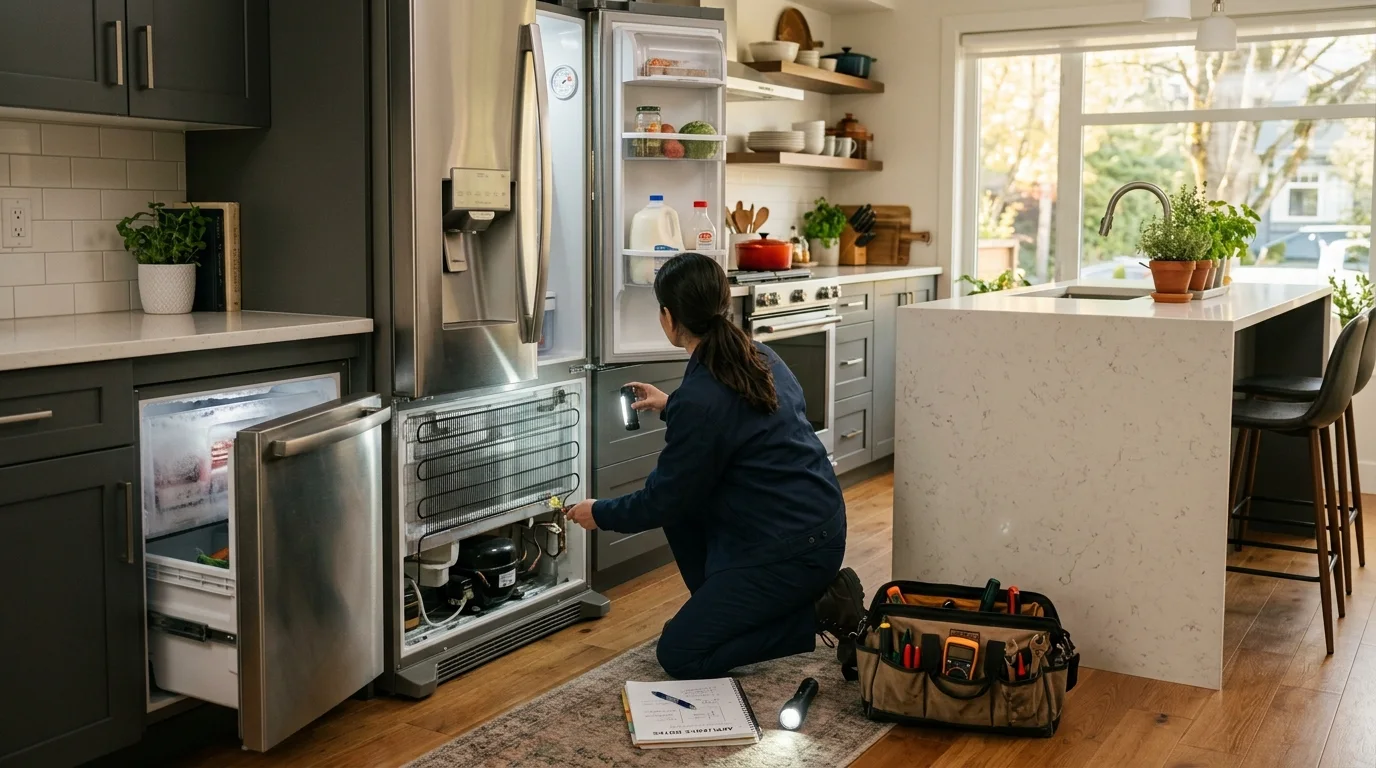
A fridge that’s not cooling needs two decisions at once: protect food if the measured temperature is unsafe, and identify what part of the cooling process has changed. Airflow, frost, condenser conditions, fans, starting components, controls and sealed-system faults can overlap in outward symptoms, so a warm cabinet does not prove the compressor has failed.
Running but Warm vs. Not Running at All
A refrigerator that is running but not cooling enough means one or more components responsible for moving or producing cold air have failed or are underperforming. A unit that is not running at all shifts attention toward the power path, controls, starting components and compressor operation. The distinction matters because the diagnostic path is different for each.
Health Canada recommends keeping your refrigerator at 4 degrees Celsius (40 degrees Fahrenheit) or below. If the measured temperature is above that, treat food safety as a separate priority from the appliance diagnosis. Move high-risk perishables to another refrigerator or a cooler with ice if safe refrigeration cannot be maintained, and use current Health Canada safe food storage guidance when the temperature history is uncertain. A power outage has its own guidance: Health Canada notes that an unopened refrigerator will generally keep food cold for about four hours, but that timing should not be treated as a universal rule for every mechanical cooling failure.
When to Stop Using the Fridge Immediately
Most fridge-not-cooling situations are inconvenient rather than dangerous. However, a few specific signs mean you should unplug the appliance and keep people away from it until a technician can take a look:
- Burning smell or visible scorching near the unit: An acrid or electrical burning odour suggests something is overheating internally. Unplug the fridge and do not use it.
- Sparking or a circuit breaker that keeps tripping: A breaker that trips once may be a one-time event. One that trips again after being reset points to a wiring or compressor problem that needs professional diagnosis before the unit is used again.
- Unusual hissing near the back or bottom of the unit, or an oily residue around the compressor area: Refrigerant leaks are uncommon but possible, particularly in older sealed systems. This is not a homeowner repair.
If none of the electrical or sealed-system warning signs above are present, you can continue observing the appliance while working through the external checks below. That does not mean food is safe to remain inside a warm refrigerator. If the measured temperature is above 4 degrees Celsius, protect high-risk perishables separately rather than relying on the fridge while you diagnose the cooling problem.
Symptom Patterns That Point the Diagnosis
Noting a few details about how the fridge is behaving before calling a technician makes the diagnostic visit faster and gives the technician a useful starting point.
Freezer is cold but the fridge section is warm. This is a useful symptom pattern because the freezer and fresh-food sections depend on the same cooling system but may differ in airflow. In most modern refrigerators, cold air is generated at the evaporator coils in the freezer and circulated into the fresh-food section by an evaporator fan. If the freezer is working normally but the fridge section is warm, the first diagnostic suspects are often airflow, damper, fan, or defrost problems between the two compartments. Possible causes include a failed evaporator fan motor, a damper that is not opening correctly, or ice from a defrost-system problem blocking the air path. This pattern often moves airflow and defrost checks ahead of sealed-system diagnosis, but it does not rule out every other cause.
Both sections are warm or only slightly cool. When neither compartment is maintaining temperature, the diagnostic range becomes broader. A defrost system that has failed can allow ice to build up on the evaporator until airflow is restricted in both sections, while power, fan, control, relay, or sealed-system faults can create a similar whole-unit cooling complaint. A failed start relay can also prevent the compressor from starting at all. An actual compressor or sealed system failure is the most serious possibility, and one a technician can evaluate with pressure testing and electrical checks.
Fridge is warmer than usual but not completely off. Gradual cooling loss without a complete failure often points to dirty condenser coils reducing efficiency over time, a slowly failing fan, or a door gasket that has started letting warm air in.
Fridge cycles on and off frequently or runs almost constantly. Excessive cycling or continuous running without reaching the set temperature can indicate a refrigerant issue, a coil problem, or a thermostat or thermistor fault. Both patterns put additional stress on the compressor over time.
Common Cause Groups
Refrigerator cooling problems tend to fall into several recurring cause groups. The symptom pattern helps decide which group deserves attention first, but the order is not universal and the exact design varies by model.
Airflow Problems
Cold air is circulated through both the freezer and fresh-food sections by fans. The evaporator fan, located inside the freezer compartment, is the main driver. If it fails, the fridge section loses cooling even while the freezer stays cold. A blocked air duct, usually caused by ice from a defrost system failure, produces a similar result. Airflow problems are an important cause group because a fan, damper, or ice blockage can reduce cooling without proving that the sealed refrigeration system has failed.
Defrost System Failure
Frost-free refrigerators run automatic defrost cycles to prevent ice from accumulating on the evaporator coils. The defrost system includes a heater, a thermostat or sensor, a timer or control board function, and sometimes a separate thermal fuse. When any of these components fail, ice builds up on the coils over days or weeks until airflow is blocked. This is frequently mistaken for a compressor problem because both compartments eventually lose cooling as the ice blocks all airflow. A technician can confirm this by checking defrost component continuity or by observing whether the problem temporarily resolves after the unit is unplugged and allowed to fully thaw before being restarted.
Dirty Condenser Coils
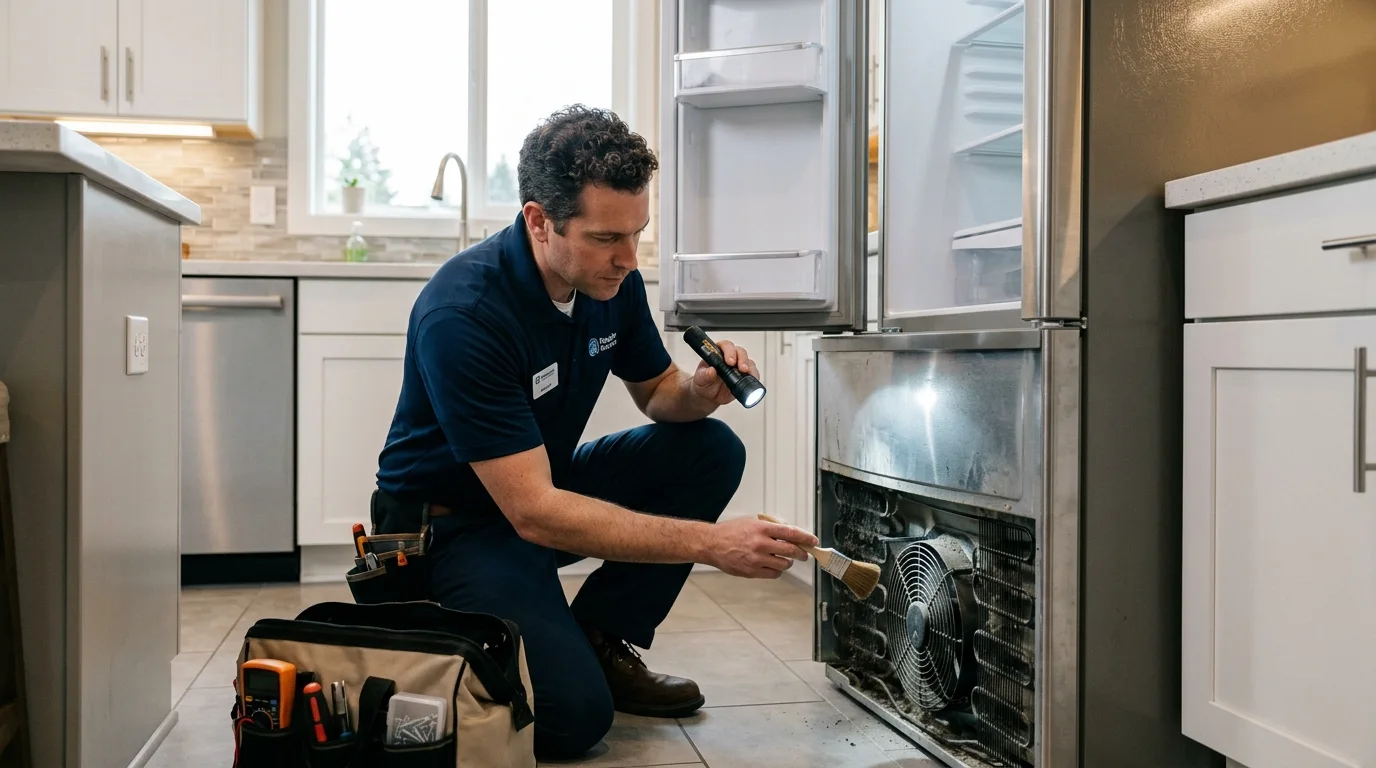
The condenser coils release heat from the refrigerant to the surrounding room air. When they are heavily coated in dust and debris, the refrigerator cannot shed heat efficiently and cooling performance drops. On many models, the condenser is located underneath the unit or at the back, where it collects dust over months and years of operation. Coil cleaning is one of the few maintenance tasks that can genuinely prevent cooling problems and is a safe homeowner task on models where the coils are accessible from the front toe grille or the back panel.
Start Relay and Electrical Component Failure
The start relay is a small component that helps the compressor motor initiate its cycle. When it fails, the compressor cannot start, and the fridge stops cooling entirely. A repeating click from the compressor area can be a clue that the start circuit is having trouble, but the sound alone does not prove the relay has failed. Control-board faults can also disrupt defrost, fan operation, or compressor cycling and require model-specific testing before replacement is recommended.
Sealed System and Compressor Problems
The sealed system includes the compressor, condenser, evaporator, and refrigerant lines. A refrigerant leak, a failing compressor, or a restriction in the refrigerant circuit can stop the system from producing cold temperatures. Sealed-system diagnosis requires specialized tools and should be left to qualified refrigeration service professionals. These repairs can be more involved, which is why a thorough diagnosis matters before assuming the compressor needs replacement. Defrost, airflow, relay, and control problems can create similar outward symptoms.
Safe Checks Before Calling a Technician
Several checks are safe to perform before calling a technician. None of these involve opening sealed components or handling refrigerant.
- Check the power supply. Confirm the refrigerator is plugged in and that the circuit breaker for the kitchen circuit has not tripped. If the interior light is not turning on, power is the right starting point.
- Check the temperature settings. Controls can be accidentally adjusted when loading groceries. Set the fridge to its recommended position and give it several hours to respond before concluding there is a mechanical fault.
- Inspect the door seals. Run your hand along the full edge of the door gasket while the door is closed and feel for air leaking in. A sheet of paper placed in the door when it closes should require noticeable resistance to pull out. Torn, cracked, or loose gaskets allow warm air to enter continuously.
- Check for blocked internal vents. Overpacking the fridge can push items against the air vents that circulate cold air through the compartment. Check that nothing is pressed directly against the back wall vents or the duct opening that connects to the freezer section.
- Verify clearance at the back and sides. Refrigerators need space around them to dissipate heat from the condenser. A unit pushed flush against the wall with no rear clearance runs harder and may not maintain temperature in warm conditions, particularly in summer.
- Clean accessible condenser coils. If your model has coils accessible from the front toe grille or the back panel, a vacuum with a brush attachment can remove built-up dust. Always unplug the unit before doing this.
- Listen for fan operation without defeating safety switches. Fan behaviour varies by model, and many refrigerators stop a fan when a door is open. Note whether you can hear normal fan activity during regular operation, but do not hold or bypass a switch if the manufacturer instructions do not specifically direct that check.
What a Technician Will Check
A professional diagnostic visit for a fridge that is not cooling typically works through several system checks before a repair recommendation is given. Understanding this process helps set realistic expectations about what the visit involves and why it is useful before committing to a repair.
The first thing a technician usually does is establish the symptom pattern. Whether the freezer is cold or not is the key initial question, because it immediately separates airflow problems from sealed system problems and guides the rest of the diagnostic.
Depending on what the symptoms suggest, a technician may check some or all of the following:
- Door gasket condition and seal quality along the full perimeter
- Condenser coils for dust accumulation and coil condition
- Condenser fan and evaporator fan motors for operation, audible noise, and continuity using a multimeter
- Defrost system components including the defrost heater, thermostat, thermal fuse, and the defrost cycle function through the control board
- Start relay for continuity or visible signs of failure
- Thermistor or temperature sensor accuracy, since a faulty sensor can cause the control board to misread internal temperatures and allow the fridge to run too warm
- Control board for error codes, visibly burned components, or faulty outputs
- Sealed system pressure using refrigeration gauges if other components check out and a compressor or refrigerant problem is suspected
The value of a proper diagnostic is that multiple component failures can produce identical symptoms. Replacing a start relay on a compressor that has actually failed wastes the repair cost. A complete diagnostic also gives you the information needed to make a sensible repair-versus-replacement decision with clear facts rather than guesswork. For more on the GTA service context, Refrigerator Repair Toronto covers what is involved in a professional refrigerator assessment.
Repair or Replace: What to Consider After Diagnosis
Age matters, but it should not decide the outcome by itself. Start with the confirmed failure, then consider the refrigerator’s overall condition, repair history, parts availability, the quoted repair scope, and what a comparable replacement would offer.
Sealed-system or compressor work can make the comparison more consequential because the repair is more involved, but even then the diagnosis should come first. For a general framework on weighing the actual repair against replacement after the cause is known, Repair or Replace Appliance covers the main factors to consider.
When to Request Appliance Repair
If the homeowner checks have not identified or resolved the issue, or the symptom points to a component that requires tools or expertise beyond what is safe to handle at home, a professional assessment is the practical next step. Delayed diagnosis can lead to preventable food loss and, in some cases, additional component stress from a system continuing to run in a degraded state.
For a fridge not cooling in the Greater Toronto Area, you can Request Appliance Repair to connect with an independent appliance repair contractor. Include the measured temperature, whether the freezer is also affected, any sounds you’ve noticed, and how long the problem has been developing.
Frequently Asked Questions
What are the most common cause groups for fridge not cooling?
Common cause groups include airflow problems such as a failed evaporator fan or blocked air duct, defrost-system failures that allow ice to build up on the evaporator, condenser or heat-rejection problems, start-relay or electrical faults that keep the compressor from starting, and sealed-system or compressor problems. The symptom pattern helps determine which group should be tested first.
Which checks are safe for a homeowner to make?
Safe homeowner checks include verifying power and the circuit breaker, confirming that temperature settings have not been accidentally changed, inspecting door seals for gaps or tears, clearing blocked internal air vents, ensuring the unit has adequate clearance at the back and sides, cleaning accessible condenser coils with the unit unplugged, and listening for the evaporator fan when the compressor is running. Any check that involves opening sealed refrigerant components, working inside the electrical control cabinet, or handling refrigerant lines is not a homeowner task.
Which warning signs mean the appliance should not be used?
A burning smell, visible sparking, or a circuit breaker that trips again after being reset are reasons to unplug the fridge and stop using the appliance until it is assessed. Unusual hissing near the sealed-system area or oily residue also warrants professional evaluation. If those warning signs are absent, the appliance can be monitored while you arrange service, but food safety is separate: high-risk perishables should not remain in a refrigerator that is above 4 degrees Celsius.
What may a technician test before recommending repair?
A technician will typically inspect door gasket condition, check condenser coil cleanliness, test fan motor operation and continuity, check defrost system components including the heater and thermostat, test the start relay, evaluate temperature sensors, and check the control board for faults. If all other components appear normal, pressure testing of the sealed system may be carried out to evaluate the compressor and refrigerant circuit. The goal is to confirm the actual failed component before recommending a specific repair, which avoids replacing parts that are not the root cause.
Need Appliance Repair?
Share the appliance, brand, address, symptoms and optional photos online. A contractor can review the request and contact you about availability and next steps.
Start Your Repair Request