
GE Washer Not Spinning: Common Causes
GE washer not spinning? Confirm the load is balanced, water has drained, and the lid or door closes properly before suspecting a drive or motor problem.
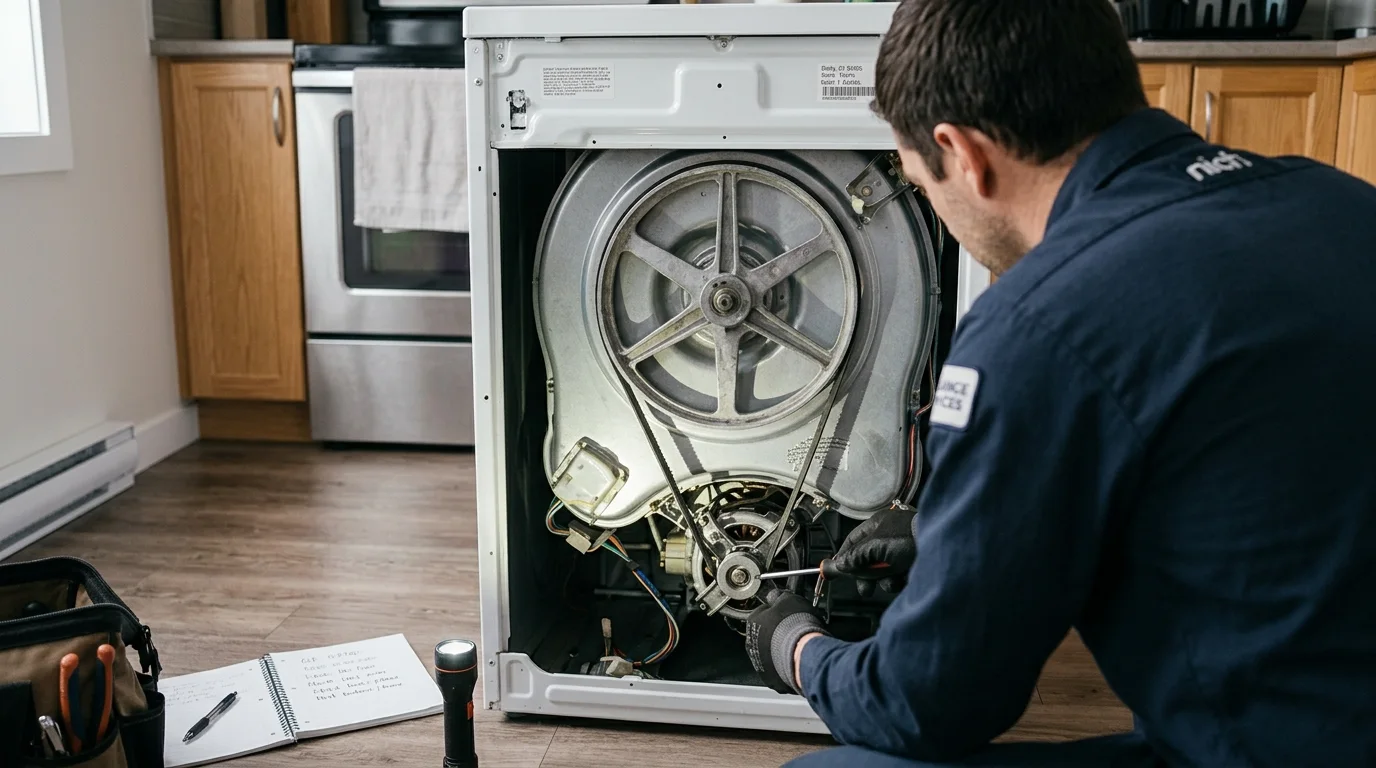
A GE washer not spinning can be caused by an unbalanced load, a lid or door condition, a drain problem, an incorrect cycle state, or a fault in the drive, motor, suspension, or control system. GE’s own support guidance separates top-load and front-load behaviour, which matters because the clues are not identical. Start with what the washer does before spin and whether it drains normally.
Top-Load and Front-Load GE Washers Do Not Fail the Same Way
GE publishes separate no-spin guidance for top-load and front-load washers. On top-load models, GE highlights power, lid position, load balance, levelling, and certain option or status conditions. On front-load models, GE also points to power and load size, and notes that some machines will not spin if the dispenser drawer is not fully closed.
That is a useful reminder not to use one generic washer checklist for every GE model. A top-load lid system and a front-load door-lock system serve similar safety purposes, but they are not the same mechanism and should not be diagnosed the same way.
For a related next step, read washer dryer repair Toronto.
GE’s current top-load washer does not spin guidance is a good reference for the observable checks that come before internal repair.
GE Washer Not Spinning: Separate Spin From Drain
Clothes can come out soaking wet for two very different reasons. The washer may have failed to remove water from the tub, or it may have drained but never reached full spin speed.
Water is still standing in the tub. Drainage becomes part of the diagnosis. A washer may delay or prevent full-speed spin if it cannot remove water normally.
The tub is mostly empty but clothing is very wet. Load balance, lid or door signals, suspension, drive, motor, and control issues move higher on the list.
The washer begins to spin, bangs or shakes, then slows or stops. Load distribution, machine levelling, or suspension support becomes especially important.
The washer never attempts to spin and the lid or door status seems abnormal. The safety interlock path deserves attention before the drive system is blamed.
GE-Specific Status Clues Can Help
On many newer GE top-load washers, a flashing Spin light or a balancing message can indicate that the machine detected an out-of-balance condition and could not reach normal spin speed. GE recommends redistributing the load and running the appropriate spin or drain-and-spin cycle for those models.
That is a good example of a display message narrowing the system without identifying a failed part. If the same washer repeatedly reports imbalance with ordinary balanced loads, the next question becomes why the basket cannot stay controlled during acceleration.
Model differences matter. If your washer uses different lights or wording, use the owner manual for that exact model instead of assuming a code or status message means the same thing across the entire GE line.
When to Stop Using the Washer
- Stop for a burning smell, smoke, or visible heat damage. Do not keep running spin tests.
- Stop if the washer repeatedly trips the breaker. Repeated resets can hide an electrical fault.
- Stop if the basket bangs violently against the cabinet. Severe movement can damage the washer or surrounding property.
- Stop if water is leaking onto the floor. A drain or tub problem can become an electrical and building-damage issue.
- Stop if the lid or door will not lock or unlock normally. Do not force or bypass the safety system.
Common Cause Groups
Unbalanced or Oversized Load
GE specifically identifies load balance as a reason some top-load washers cannot spin properly. Heavy items can collect on one side of the basket, and oversized loads can prevent the washer from distributing weight evenly.
The useful test is simple: redistribute the items or try a smaller balanced load. If the washer spins normally afterward, that result tells you more than a parts list does.
Washer Is Not Level or Stable
A washer that rocks on the floor has a harder time controlling the basket during acceleration. GE includes levelling in its top-load no-spin guidance because machine stability affects how the control responds to an out-of-balance condition.
All feet should contact a solid surface. If the washer was recently moved, installed on new flooring, or shifted during use, stability is worth checking before internal diagnosis.
Lid, Door, Lock, or Dispenser Condition
Top-load washers need the lid in the correct state for spin. Front-load washers rely on a door-lock system, and GE notes that certain front-load models also require the dispenser drawer to be fully closed before spin.
A washer that fills and washes but never transitions into spin can therefore have a safety-signal problem even when the motor and basket are mechanically capable of turning.
Drainage Problem
Spin and drain are closely related. If water remains in the tub, check the drain hose and household drain path before treating the problem as purely mechanical. A kinked hose or restricted drain can leave clothing wet and prevent the normal end-of-cycle spin sequence.
Listen for the drain pump and observe whether the water level actually falls. A pump sound without water movement is a clue, not proof that the pump has failed.
Drive, Motor, or Control System
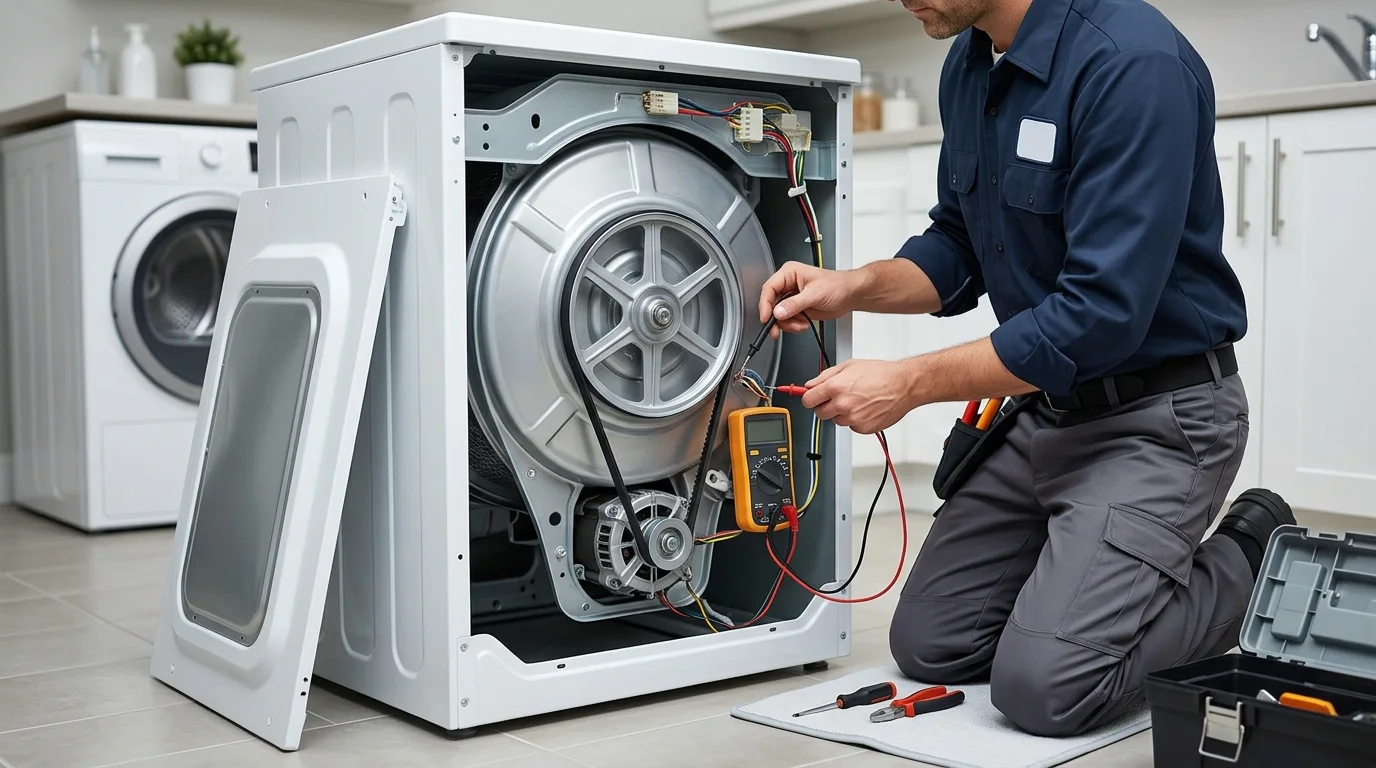
Once load, levelling, interlock, and drainage issues are ruled out, the drive system becomes more important. Depending on the GE washer design, torque may be transferred through a belt, motor-driven system, transmission or gearcase components, or other drive hardware.
A motor or control fault can also prevent the basket from accelerating to spin speed. The exact design determines which components and test values apply, so generic resistance numbers or parts-swapping instructions are not reliable.
Suspension or Basket-Support Problem
Suspension parts control basket movement during spin. Worn, damaged, or displaced supports can make an otherwise balanced load behave as if it is severely out of balance. This is especially relevant when the washer repeatedly shakes or aborts spin with ordinary loads.
Basket, bearing, or support problems may also create scraping, grinding, looseness, or abnormal movement when the machine is off.
Safe Checks You Can Make
- Redistribute the load. Separate tangled or heavy items and avoid one large item sitting on one side of the basket.
- Try a smaller balanced load. This helps distinguish a loading problem from a repeatable machine fault.
- Confirm the washer is level and stable. Check for rocking and make sure all feet are supported.
- Check the lid, door, and dispenser drawer where applicable. Close them normally and remove any clothing or debris interfering with closure.
- Confirm the tub drains. If water remains, inspect the visible drain hose for kinks and note what the pump sounds like.
- Check the selected cycle and status indicators. Use the exact GE owner manual to interpret balancing messages, flashing lights, or special cycle behaviour.
- Check household power if the washer stopped completely. Do not repeatedly reset a breaker that continues to trip.
If a model-specific GE reset procedure appears in the official documentation for your exact washer, follow that documentation. Do not apply a reset sequence from another GE platform simply because it appears in a video or forum post.
What the Symptom Does Not Prove
“It does not spin” is not a motor diagnosis. A washer can refuse to spin because the control believes the load is unbalanced, because the lid or door signal is missing, because water has not drained, because the basket cannot move correctly, or because the motor or drive system has a real fault.
The same principle applies to sound. Humming does not prove the motor is bad. Banging does not prove the suspension is bad. A repeated symptom only becomes diagnostic when it is paired with load condition, water level, basket movement, and the washer’s status information.
What a Technician May Inspect or Test
A technician can reproduce the complaint with a controlled load and verify whether the washer drains before attempting full spin. The lid or door interlock can be checked for proper operation, and the machine can be evaluated for repeatable balance or suspension problems.
If the basket still will not spin, the drive path can be inspected. Depending on the model, that may include the belt, motor, pulleys, transmission or gearcase components, basket support, speed sensing, wiring, and control outputs.
Electrical testing can determine whether the motor is being commanded and whether the relevant circuits are intact. Mechanical inspection can determine whether the basket or drive system is binding. Those two findings separate a control problem from a load the motor physically cannot turn.
Diagnostic history or model-specific service modes may provide additional clues, but they should be interpreted with the actual symptom. A stored code is evidence about a system, not an automatic instruction to replace the component named most often online.
What Happens Before Spin Is Often the Best Clue
Watch the last minute or two before the washer should accelerate. A machine that drains strongly, locks correctly, and then repeatedly aborts acceleration has a different problem from one that never removes the water or never confirms the lid or door state.
If the basket makes several short attempts to distribute the load before stopping, the control may be responding to imbalance rather than suffering a complete drive failure. If the motor sound changes but the basket barely moves, the drive path becomes more important. If nothing happens after drain, the interlock, control command, or electrical path deserves attention.
This sequence is useful because it narrows the system without opening the washer. It also gives the technician a repeatable symptom to test rather than a broad statement that the clothes were wet.
Repeated Imbalance With Normal Loads Is Different From One Bad Load
One bulky blanket or a small load of heavy towels can create a legitimate imbalance. That is normal enough that GE includes load redistribution in its support guidance. The concern changes when ordinary mixed loads repeatedly trigger balancing behaviour or violent movement.
At that point, machine levelling, suspension support, basket movement, and sensing become more important. A washer that cannot control the basket may protect itself by reducing or cancelling spin. The protection response does not prove which support component is worn, but it tells the technician where to look next.
One Successful Spin After Redistributing the Load Is Useful Evidence
If the washer completes a normal spin after a bulky or tangled load is redistributed, that result supports a load-balance explanation for that cycle. It does not guarantee the suspension is perfect, but it shows that the machine can still reach spin under a better load condition.
If ordinary loads continue to trigger the same imbalance behaviour, the evidence changes. Repeated failure under normal conditions is a stronger reason to inspect levelling, suspension, basket support, sensing, and the drive system rather than treating every cycle as user loading error.
Repair or Replace Context
A GE washer not spinning can be caused by a loading issue, an interlock repair, a drain problem, a suspension repair, or a larger drive-system fault. Those repairs are too different for a useful decision before diagnosis.
Once the fault is confirmed, compare the repair with the washer’s condition, repair history, installation, and realistic replacement choice. Avoid universal age cutoffs and fixed percentage rules that ignore the actual repair.
When to Request Appliance Repair
Professional assessment is appropriate when balanced loads repeatedly fail to spin, the washer cannot drain, the lid or door system behaves abnormally, the basket shakes violently, or the machine makes grinding, burning, or electrical warning signs.
To arrange an assessment, Request Appliance Repair. Before the visit, note whether the washer is top-load or front-load, whether water remains in the tub, whether it tries to accelerate, what status lights or messages appear, and whether the problem happens with every load or mainly with bulky items.
Need Appliance Repair?
Share the appliance, brand, address, symptoms and optional photos online. A contractor can review the request and contact you about availability and next steps.
Start Your Repair Request