
Refrigerator Water Dispenser Not Working: Common Causes
Refrigerator water dispenser not working? Trace shutoff, filter, lock and flow clues to separate an upstream water issue from a dispenser fault.
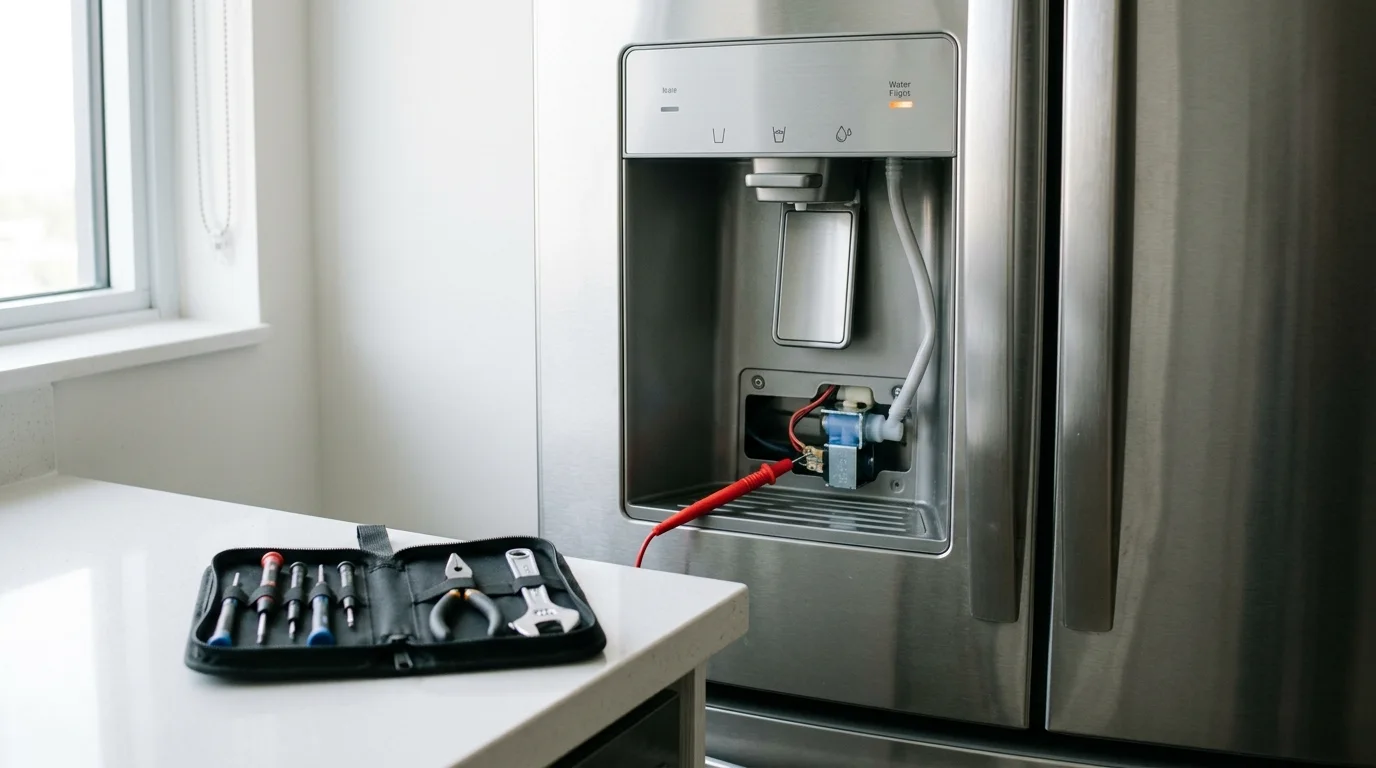
If your refrigerator water dispenser not working problem is new, first decide whether the dispenser has no flow, weak flow, or intermittent flow. Then check the shared water-supply basics before assuming the dispenser itself has failed. A closed supply, kinked line, restricted or incorrectly installed filter, control lock, trapped air after filter service, frozen water path, switch problem, valve problem, or control issue can create similar symptoms.
The best clue is whether the ice maker still receives water. If both ice production and water dispensing stop together, the shared upstream water path becomes more important. If ice production continues normally while the dispenser is dead, the problem is more likely in the dispenser-specific path or controls.
Refrigerator Water Dispenser Not Working: Identify the Flow Pattern
No water at all is different from a dispenser that has slowly become weaker. A total stop can follow a shutoff, line kink, control lock, improperly seated filter, frozen path, failed activation switch, or valve/control problem. A gradual decline is more consistent with increasing restriction, such as filter loading or a line condition, although it still needs confirmation.
Intermittent flow adds another clue. If the dispenser works after the refrigerator is moved, after the door is opened, or only after repeated paddle presses, note that pattern. Do not force the paddle or repeatedly cycle the dispenser if you hear abnormal electrical sounds or see water leaking.
Whirlpool’s current water-dispenser guidance includes checks for control lock, filter replacement, water-line installation, filter condition, water supply, and full paddle engagement. Those are useful owner-level checks because they do not require internal service work.
Did the Problem Start After a Filter Change?
Timing matters. If the dispenser stopped immediately after installing a filter, verify that the filter is the correct type for the refrigerator and fully seated as the owner’s instructions require. An incorrectly installed filter can reduce or stop flow on some systems.
Air can also enter the water path after filter service or other plumbing work. GE’s current dispenser support guidance notes that the water system may need to be filled and air purged after service on applicable models. Follow your own refrigerator’s owner instructions for flushing rather than applying a universal time or volume from another model.
If flow was strong before the filter change and immediately poor after it, that sequence is more useful than assuming an internal valve suddenly failed at the same moment.
Compare the Water Dispenser With the Ice Maker
On many refrigerators, the dispenser and ice maker share the household water supply and part of the inlet system. That makes the ice maker a useful comparison point.
No dispenser water and no ice production: Start farther upstream. Confirm that the household water valve is open, the line is not visibly kinked, the filter is correctly installed, and the refrigerator is actually receiving water.
No dispenser water but normal ice production: The refrigerator is receiving at least some water. The problem can be more specific to the dispenser line, reservoir, paddle or switch, door condition, valve branch, or control path.
Weak dispenser flow and small or reduced ice production: A shared restriction becomes more plausible, including the filter or supply path. That is a clue, not a parts diagnosis.
Trace the Water Path From the House to the Glass
A refrigerator dispenser is easier to understand when you picture the water path in order. Water begins at the household supply, travels through the shutoff and supply tubing, enters the refrigerator, passes through the filter system on filtered models, moves through model-specific tubing or a reservoir, then reaches the dispenser outlet when the controls and valve sequence allow it.
A restriction anywhere upstream can make the dispenser appear dead. A control problem near the end of the path can create the same visible symptom even when the refrigerator has plenty of water available. This is why replacing the dispenser switch or inlet valve without tracing the path can miss the actual cause.
What Changed Immediately Before the Dispenser Stopped?
The timeline is one of the strongest clues. If the refrigerator was pulled away from the wall, the supply line may have been bent or pinched. If a water filter was replaced, installation, compatibility, trapped air, or a filter restriction becomes relevant. If household plumbing was shut off, air or a closed valve may be involved. If food has also started freezing in the fresh-food section, a frozen internal water path becomes more plausible on designs where tubing passes through a cold area.
Write the event down before changing anything else. A symptom that begins within minutes of service or movement should not be treated the same as a dispenser that gradually weakened over several months.
No Flow, Weak Flow, and Delayed Flow Are Different Complaints
No flow means the water path or activation sequence is completely interrupted at the time of the test. Listen for whether the dispenser makes any normal valve or control sound, but do not use sound to name the part.
Weak flow means water is getting through. That makes a total upstream shutoff less likely and makes restriction more useful to investigate. Filter condition, line routing, supply conditions, and model-specific valves all remain possible.
Delayed or sputtering flow can occur after filter or plumbing work when air is present, but it can also accompany inconsistent supply or other water-path conditions. Follow the manufacturer instructions for flushing your model rather than applying an arbitrary quantity from another refrigerator.
Why the Ice Maker Is Such a Useful Comparison
The ice maker gives you a second demand on the same general water system. If both features fail at once, the common path becomes important. If one works and the other does not, the diagnosis can move farther downstream toward the feature that failed.
That comparison is not absolute. Some refrigerators use separate valve outlets, different tubing routes, and different control conditions. A working ice maker does not certify the dispenser path, and a working dispenser does not certify the ice-maker branch. The comparison simply helps decide where to start.
Watch for a Water Problem That Looks Like a Control Problem
A dispenser can appear electrically dead when the real issue is that no water reaches the outlet. Conversely, a healthy water supply can be present while a lock, door switch, paddle switch, or control condition prevents the valve from being commanded.
One useful observation is whether the control panel responds normally when the dispenser is pressed. Another is whether the refrigerator shows a lock indicator or door-open condition. Do not enter hidden diagnostics or bypass interlocks. The goal is only to distinguish a user-control condition from a deeper service issue.
When Frozen Tubing Is Part of a Bigger Temperature Problem
On some designs, internal water tubing can freeze if the surrounding area becomes too cold. If that happens once, a model-specific thaw procedure may restore flow. If it happens repeatedly, the important question is why that section is freezing. Food-freezing complaints, damper behaviour, airflow, sensing, or control conditions may need to be investigated.
Do not apply a hair dryer or other concentrated heat to hidden plastic tubing unless the manufacturer specifically instructs it. Heat can damage liners, wiring, insulation, or tubing and may create a leak after the original blockage is gone.
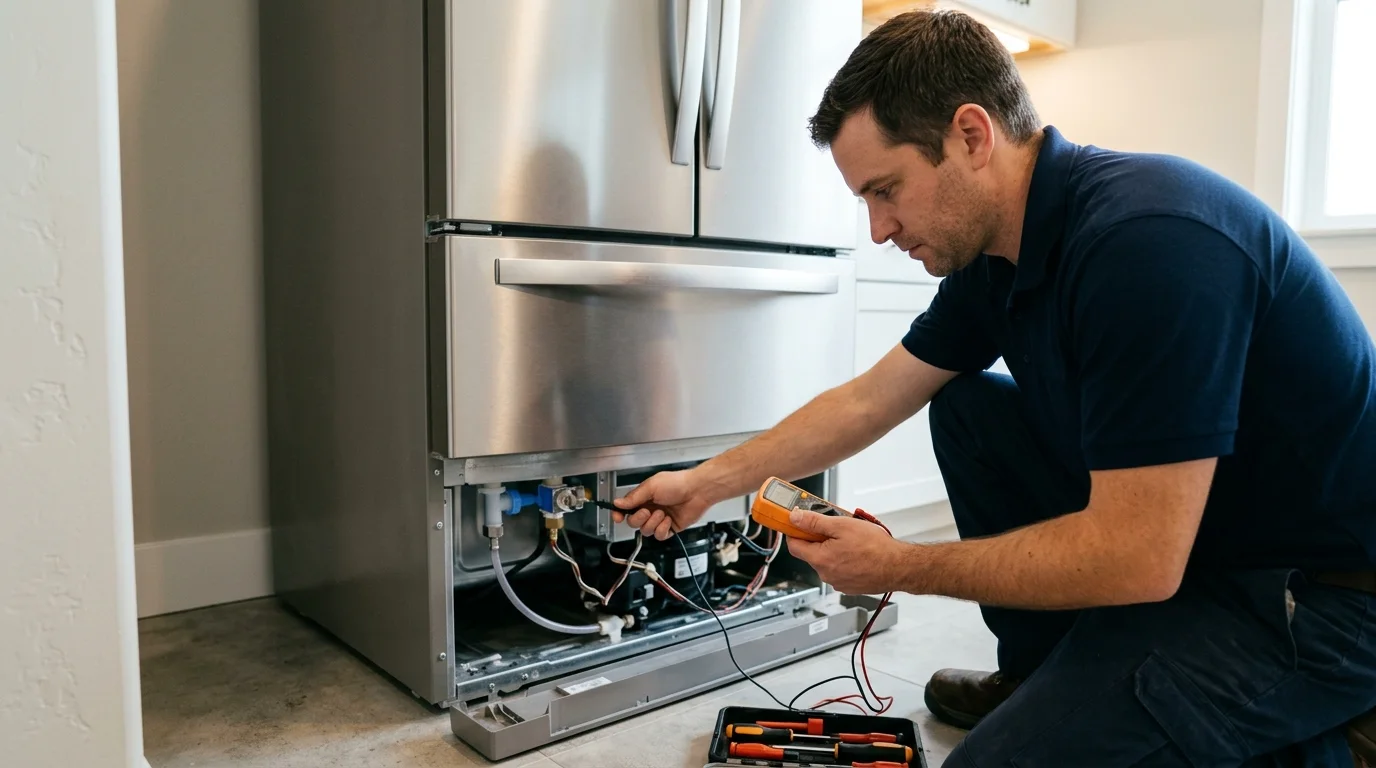
Common Cause Groups
Household water supply or accessible line problem
A shutoff valve that is closed, a recently disturbed connection, or a kinked line behind the refrigerator can stop flow before the appliance has a chance to dispense anything. If the refrigerator was moved recently, look for an accessible line that has been pinched. Do not pull hard on a refrigerator connected to a short water line.
Filter restriction or installation problem
A filter can restrict flow when it is loaded, damaged, incompatible, or not seated correctly. Because filter systems differ, use the model’s approved filter and installation procedure. Do not improvise a bypass unless the owner documentation specifically provides one for your model.
Control lock or dispenser activation problem
Some models disable dispensing when a control lock is active or when a door is open. Others depend on a paddle or switch being fully engaged. Check only the normal user controls. If the display indicates a lock, follow the owner’s instructions to disable it.
Frozen water path or reservoir condition
Some designs route water through a chilled reservoir or tubing in cold areas. A localized freeze can stop flow while other refrigerator functions remain normal. Repeated freezing can point to a temperature or airflow issue as well as the water path itself, so do not treat thawing alone as a permanent repair.
Valve, switch, wiring, or control fault
If the refrigerator receives water and accessible restrictions have been ruled out, professional diagnosis may move to the inlet valve, dispenser switch, wiring, door interlock, control board, or other model-specific components. The same no-flow symptom can occur at several points in that chain.
Safe Checks a Homeowner Can Make
Confirm that the refrigerator has water service and that the household shutoff was not recently closed. Look for an obvious kink in the accessible line. Check the filter installation and control lock. Press the dispenser normally with a sturdy container and listen for what happens. A click or hum with no water is different from complete silence, but neither sound alone identifies the failed part.
Check for leaks around the filter housing, dispenser area, and accessible supply connection. If there is active leaking, stop dispensing and control the water supply if the shutoff is safely accessible. Water around electrical components is a reason to stop testing.
Note whether the ice maker works. Also note whether the symptom started after a filter change, move, plumbing interruption, or freezing-food problem. Those details can shorten the diagnostic process.
What a Technician May Test
A technician can trace the water path from source to outlet instead of guessing. That can include confirming supply pressure against the model requirement, checking the filter and housing, verifying inlet-valve operation, inspecting tubing for restriction or freezing, checking a reservoir where applicable, and testing dispenser switches, door interlocks, wiring, and control signals.
If the ice maker also has no water, the diagnosis may stay on the shared supply path longer. If the ice maker is normal, attention can shift to the dispenser-specific branch. This branching method is more reliable than replacing a valve because “no water” appears in a symptom list.
What to Tell a Technician About the Water Problem
A useful service note should include more than “no water.” Record whether the dispenser is completely dry, weak, sputtering, or intermittent. Note whether the ice maker is still producing ice, whether the filter was changed recently, whether the refrigerator was moved, and whether household plumbing work happened near the time the symptom started.
If the dispenser makes a sound when pressed, describe it without guessing what it means. If it is silent, record that too. If water starts only after a delay or stops after a few seconds, include that timing. These details help a technician decide whether to begin with the shared supply path, the dispenser activation path, or an internal restriction.
Also report any freezing-food symptom, filter-housing leak, water under the refrigerator, or control-panel message. A dispenser complaint can be related to another refrigerator condition, and those companion symptoms can change the diagnostic order.
When to Request Appliance Repair
Professional assessment is sensible when the supply is on, the line is not visibly kinked, the filter is correctly installed, the controls are unlocked, and the dispenser still has no or abnormal flow. Request service sooner if there is leaking, an electrical smell, repeated control faults, frozen tubing that keeps returning, or another refrigerator temperature problem.
For related service information, see refrigerator repair Toronto. To provide the model number, filter history, ice-maker behaviour, and dispenser-flow pattern, Request Appliance Repair.
Why Weak Flow Can Be More Informative Than No Flow
A dispenser that still produces some water tells you the system is not completely blocked. Compare whether the flow changed suddenly or gradually. A gradual decline after months of use can fit increasing restriction. A sudden drop immediately after moving the refrigerator or changing a filter points toward a different set of conditions.
Also compare the first few seconds with continued dispensing. Flow that starts strong and quickly fades can suggest a different supply behaviour from flow that is consistently weak. These observations do not diagnose a valve or filter by themselves, but they give a technician a repeatable symptom to test.
Refrigerator Water Dispenser Not Working: Practical Takeaway
A refrigerator water dispenser not working is best diagnosed as a water-path problem, not a single-part problem. Start at the supply, filter, accessible line, and user controls. Compare the dispenser with the ice maker. Note whether the problem is no flow, weak flow, or intermittent flow and whether it began after filter or plumbing work. If the cause is not clear from safe checks, professional testing can identify where the water path or activation sequence stops.
Need Appliance Repair?
Share the appliance, brand, address, symptoms and optional photos online. A contractor can review the request and contact you about availability and next steps.
Start Your Repair Request