
Samsung Washer Not Spinning: Common Causes
Samsung washer not spinning? Check load balance, drainage, and door or lid status before assuming a motor or drive part has failed. Learn what to verify first.
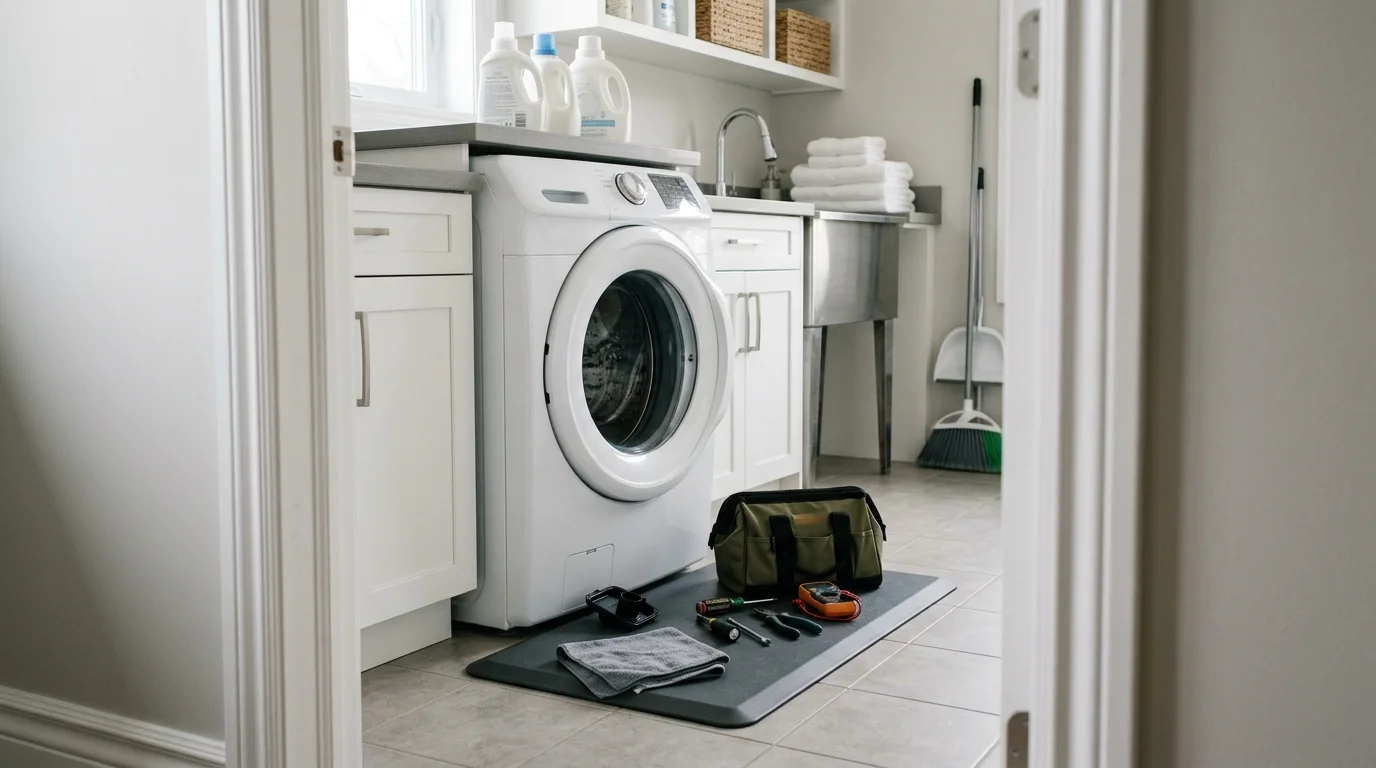
The most common mistake with a Samsung washer not spinning is jumping straight to a bad motor. A Samsung washer may refuse high-speed spin because the load is unbalanced, the machine is not level, water has not drained, the door or lid signal is not satisfied, or the drive system cannot turn the drum properly. Start with the load and water level before assuming an internal component has failed.
Samsung Washer Not Spinning: Check the Simple Conditions First
Look inside the washer before doing anything more complicated. Is the load bunched to one side? Is one heavy blanket wrapped around the rest of the laundry? Is there still water in the tub? Does the door or lid close normally? Those observations tell you more than a parts list.
Samsung’s current support separates a washer that does not spin at all from one that spins poorly. Samsung specifically notes that a no-spin complaint can be connected to a drainage issue as well as a motor-related problem. That is an important diagnostic clue: the spin failure can be a downstream symptom rather than the original fault.
For a related next step, read washer dryer repair Toronto.
Start With Load Balance and Levelling
A washer has to accelerate a heavy, wet load to high speed without letting the tub move uncontrollably. If one side of the drum carries much more weight than the other, the control may slow down, pause, add time, redistribute the load, or decline to reach full spin.
Open the washer and separate items that have formed a tight ball. If you are washing one large absorbent item, add or remove laundry only in a way that creates a more balanced load and stays within the model’s loading guidance. Do not pack the drum tightly just to prevent imbalance.
The floor and levelling feet matter too. Samsung Canada advises checking that the washer is stable and properly level. A machine that rocks on its feet has to manage both the moving load and the moving cabinet, which can make spin-control problems much more obvious.
If the washer spins normally with a balanced medium load but repeatedly struggles with a single bulky item, the machine may be reacting to load conditions rather than showing a failed motor or control.
Water in the Tub Changes the Diagnosis
Before high-speed spin, the washer normally has to remove most of the water. If the tub remains full or partly full, focus on drainage before the drive system.
Listen during the point in the cycle when the machine should drain. A steady pump sound with little water movement suggests a different problem from complete silence. A humming pump can be working against a restriction, and silence can mean the pump is not being powered or is not operating. Neither sound proves a failed pump by itself.
Samsung Canada identifies drain-hose routing, kinks, levelling, and the pump-filter area on applicable front-load models as relevant drainage checks. Front-load and top-load designs are not identical, so do not assume every Samsung washer has the same homeowner-accessible filter.
If the washer drains strongly and the tub becomes nearly empty but the drum still never accelerates, the diagnosis moves away from a basic water-removal problem and toward the spin-enabling and drive systems.
What the Door or Lid Can Tell You
The washer’s control needs the correct door or lid status before it can allow certain parts of the cycle. A front-load door lock or top-load lid system that does not confirm the expected position can interrupt spin even though the drum, belt, or motor is physically capable of turning.
Check only what is visible and normal to operate. Make sure clothing is not trapped in the opening, the door or lid closes without being forced, and any latch area is free of obvious detergent or debris. Do not bypass, hold, tape, or defeat a lid or door safety switch to make the washer run.
An error code can be useful evidence. Record the exact code and the model number if available. The code may identify the system the washer is unhappy with, but it should not automatically be translated into a replacement part.
What the Drum Does During the Cycle Matters
A washer that tumbles or agitates normally during wash but fails only at final high-speed spin has already shown that at least part of the drive system can move the drum. That does not rule out every mechanical or motor problem, but it changes the question from “can the drum move at all?” to “why can it not complete the high-speed spin stage?”
If the drum makes brief start attempts and stops, load balance, drainage, a drive-system problem, a motor-control issue, or another protection condition can be involved. If the drum never moves during any part of the cycle, the drive path, motor system, door or lid signal, or control becomes more important.
Abnormal scraping, grinding, a strong burning-rubber smell, or a drum that is obviously difficult to rotate by hand when the appliance is safely off are more concerning mechanical clues. Stop using the washer if there is smoke, scorching, a strong electrical burning smell, or repeated breaker trips.
Drive-System Problems Are a Separate Branch
Samsung washer designs vary. Some use belts, some use direct-drive arrangements, and the way the motor transfers force to the drum depends on the model. Bearings, pulleys, couplings, rotor or stator components, suspension parts, and other supports can also affect whether the drum can accelerate smoothly.
A worn drive component can sometimes allow slow movement but fail under the heavier load of high-speed spin. A mechanical drag can also make the motor work harder than normal. The symptom still does not tell you which component is responsible, because several faults can create the same “starts but will not get up to speed” behaviour.
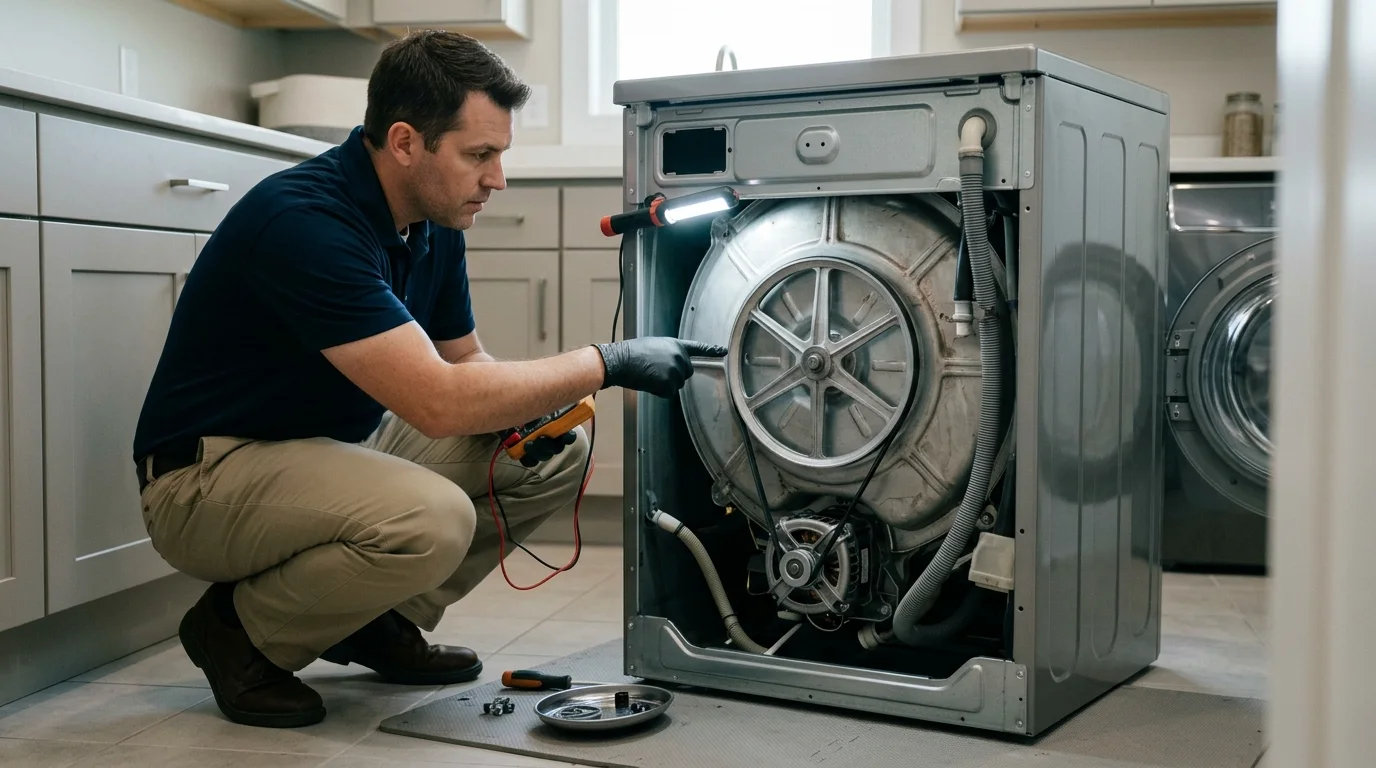
This is the point where a model-specific inspection becomes more useful than generic parts swapping. A technician can identify which component in the drive path is failing without requiring the homeowner to remove panels or probe live circuits.
Safe Checks Before You Request Repair
- Redistribute the load. Separate heavy items that have collected on one side and try a balanced load.
- Confirm the washer is stable. If the cabinet rocks on the floor, correct obvious levelling issues according to the model instructions.
- Check whether water is draining. Note whether the tub is full, partly full, or nearly empty when spin should begin.
- Inspect the visible drain hose. Look for a kink, crushing, or a recent installation change.
- Use the pump filter only if your model provides homeowner access. Follow the model instructions and prepare for retained water.
- Check the door or lid closure. Remove trapped clothing and confirm it closes normally without bypassing the safety system.
- Record codes and sounds. A Ub, UE, drainage code, clicking lock, hum, or repeated start attempt can help a technician narrow the system.
Do not remove drive-system covers, probe a powered motor circuit, or run the washer with a defeated interlock. Those steps cross the line from useful observation into model-specific repair work.
Common Troubleshooting Mistakes
Replacing the motor before checking drainage. Samsung itself notes that a drain issue can prevent spin. A motor replacement will not clear a blocked drain path.
Treating every balance code as a broken washer. An unbalanced load is a condition the machine is designed to detect. If the code returns on ordinary balanced loads with a level machine, then the repeated pattern deserves diagnosis.
Using a random calibration button sequence from another model. Samsung calibration steps differ by model and control panel. Use the manual for the exact model rather than assuming one sequence applies to every washer.
Assuming soaking-wet clothes always mean no drain. Clothes can remain very wet when high-speed spin does not occur even if most standing water has already drained. Check the actual tub water level.
What a Technician May Inspect or Test
A professional diagnosis should follow the sequence that enables spin. First, is the washer receiving the correct door or lid signal? Next, is it draining to the level expected by the control? Then, does the control command spin, and does the drive system respond?
Depending on the model, the technician may inspect the drain path, pump operation, lock or lid system, wiring, suspension, belt or drive hardware, motor components, speed feedback, and control outputs. Stored diagnostic information may help, but it still has to be interpreted against what the washer is physically doing.
The purpose of those tests is to separate a condition the washer is correctly responding to, such as imbalance or retained water, from a component that cannot perform its job. That is more reliable than choosing the best-known part from a search result.
What to Record After the Safe Checks
Once you have checked load balance, levelling, drainage, and normal door or lid closure, stop changing multiple things at once. Run only the normal model-approved cycle needed to see whether the original symptom remains, provided there are no stop-use warnings such as burning odour, smoke, leaking onto electrical areas, or repeated breaker trips.
Write down four details: whether the tub drained, whether the drum moved at low speed, whether it attempted high-speed spin, and what happened immediately before it stopped. Also record any code exactly as displayed. A note such as “drains completely, tumbles during wash, then makes two brief spin attempts and stops” gives a technician a much clearer starting point than “washer will not spin.”
If the problem began after the washer was moved, reinstalled, heavily overloaded, or connected to a different drain, mention that too. Timing does not prove the cause, but it can point the diagnosis toward installation, balance, or drainage before internal drive parts are tested.
Use the Cycle Stage to Narrow the Spin Failure
Where the cycle stops can be more useful than the fact that the final spin did not happen. If the washer fills and moves the load during wash but reaches the end with water still in the tub, the drain path deserves attention before the drive system. Samsung’s own troubleshooting separates no-spin complaints from drainage checks for this reason. A washer may be capable of moving the drum and still refuse to enter or complete high-speed spin when water has not been removed as expected.
If the tub drains fully and the machine makes one or more brief spin attempts before stopping, load balance, levelling, calibration on applicable models, and the door or lid signal become more useful clues. The control may reduce speed or stop an attempt when it detects a condition that could make high-speed spin unstable. That behaviour is not proof that a sensor, motor, or control board has failed.
If there is normal wash movement but no meaningful drum movement during any spin attempt, the drive system moves higher on the list. Belt, motor, coupling, clutch, rotor or stator components, bearings, wiring, and control outputs vary by model, so the correct test depends on the exact washer design. The symptom narrows the system. It does not identify the replacement part.
When Not to Run Another Test Cycle
Stop testing if the washer develops a burning odour, repeated hard impacts, grinding that is much louder than its normal spin sound, visible water near electrical connections, or a drum that appears mechanically jammed. Repeatedly forcing a high-speed cycle can turn a useful diagnostic clue into additional damage.
If the machine is simply refusing to spin without a stop-use warning, one controlled test with a small balanced load can be useful after the drain path and installation have been checked. If the same behaviour returns, record what happened and move to diagnosis rather than continuing to reset or reload the washer.
Repair or Replace Only After the Fault Is Known
A Samsung washer that will not spin can have a simple loading or drain-path issue, a targeted lock or pump repair, or a more involved drive or control fault. That range is too wide for a sensible repair-versus-replacement decision before diagnosis.
Consider the confirmed fault, the washer’s overall condition, whether there are other recurring problems, and the actual repair estimate. Avoid a universal age cutoff or a fixed percentage rule. A washer with one repairable fault is a different decision from a machine with repeated control, bearing, leak, and drive problems at the same time.
When to Request Appliance Repair
Request professional assessment if the washer is level and properly loaded but still will not spin, if it drains yet never reaches high speed, if a door or lid problem keeps returning, if the drum makes abnormal mechanical noises, or if a drainage or motor-related code persists after the safe checks.
If there is a burning smell, smoke, visible scorching, water near electrical parts, or repeated breaker trips, leave the washer off. For a normal non-emergency spin complaint that has reached the professional-diagnosis stage, Request Appliance Repair and include the model number, any error code, whether water drains, and exactly what the drum does before it stops.
Need Appliance Repair?
Share the appliance, brand, address, symptoms and optional photos online. A contractor can review the request and contact you about availability and next steps.
Start Your Repair Request