
Samsung Washer UE and UB Errors: Imbalance Guide
Samsung Washer UE Code guide: learn the key details, compare options, check verified sources, and make a safer decision before you act.
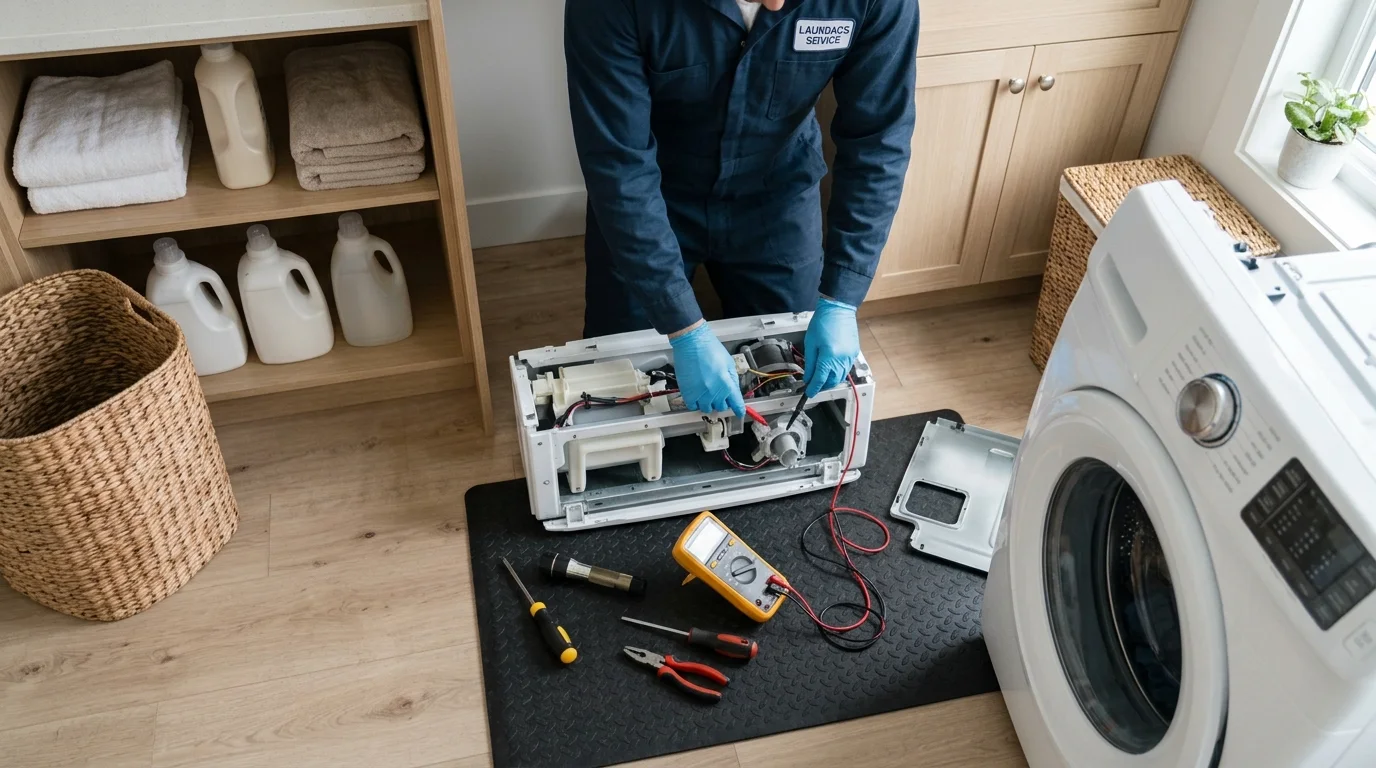
The most common mistake with a Samsung washer UE code is assuming the washer has a failed part before correcting the load. On affected Samsung models, UE and Ub belong to the unbalanced-load error family. Redistribute the laundry, avoid a single heavy item or an extremely small load, and make sure the washer is on a flat, stable surface. If the error keeps returning on normal balanced loads, then the washer itself deserves a closer diagnosis.
Samsung Washer UE Code and Ub: What the Codes Are Telling You
Samsung’s current error-code guidance groups UE and Ub with unbalanced-load conditions. Depending on the model, related displays can also appear while the washer is attempting to rebalance the load. The exact code sequence varies, so the owner manual remains the final reference for your machine.
Samsung US explains that when a load is unbalanced, the washer may slow or stop the spin, extend the cycle, or retry balancing. Samsung UK similarly describes UE as a condition where the washer detects an unbalanced load and stops the spin for safety.
For a related next step, read washer dryer repair Toronto.
You can review Samsung’s current washing-machine error-code guidance. The important takeaway is that UE or Ub is often a protective response to the load, not immediate proof that the washer is broken.
Why the Cycle Can Suddenly Take Longer
An unbalanced load becomes more obvious as the washer tries to increase spin speed. If too much wet weight sits on one side of the drum, the machine may reduce speed and try to redistribute the laundry before attempting spin again.
That retry behaviour can add time. On some Samsung models a related retry code may be shown while the machine is attempting to correct the load. Extra time in this situation does not automatically mean a second fault has appeared.
The useful question is what happens after the laundry is redistributed. If the washer completes a normal spin after the load is corrected, the error was doing its protective job. If the same imbalance warning appears repeatedly on ordinary loads, that pattern deserves more attention.
Correct the Load in This Order
1. Stop and redistribute the laundry
Pause the cycle and wait until the washer allows safe access. Separate items that have wrapped together and spread the load around the drum or basket.
Do not leave one saturated heavy item on one side. A bath mat, blanket, large towel or similar item can hold enough water to dominate the load during spin.
2. Fix a load that is too small
One or two heavy pieces can be harder to balance than a modest mixed load. If the fabrics are compatible, adding a few similar items can help distribute weight more evenly.
The goal is balance, not simply adding as much laundry as possible. A tiny load and an overloaded washer can both create trouble for high-speed spin.
3. Reduce an overloaded or tangled load
If the drum is packed tightly, remove some items. Clothing needs space to move as the washer redistributes the load. Large sheets can also trap smaller items and form one heavy bundle.
Use the appropriate cycle for bulky items when the model provides one. Follow the fabric and washer instructions rather than trying to force a heavy item through a high-speed spin that repeatedly triggers UE or Ub.
Check the Washer and Floor, Not Just the Clothes
Samsung’s current poor-spin guidance tells owners to check load size and weight as well as the floor and surrounding space. A machine that is not stable can turn a manageable load imbalance into repeated vibration.
With the washer off, press gently on opposite top corners. The cabinet should not rock. Check that all feet contact the floor firmly and that the washer is not sitting partly on a flexible mat, loose platform or uneven surface.
If levelling adjustment is needed, follow the exact Samsung installation instructions for your model. Do not use a generic calibration sequence unless the model manual specifically calls for it after installation or movement.
Use Repeatability as the Diagnostic Test
After correcting the laundry and confirming the washer is stable, run an ordinary balanced load. This is more useful than repeatedly testing with the same blanket or single heavy towel that triggered the original error.
If the normal load spins correctly: the original problem was probably load-related or setup-related.
If UE or Ub returns on several normal loads: the washer has now shown a repeatable balance problem after the easy variables were corrected. That is when suspension, sensing, drive or control conditions become more relevant.
If the washer bangs or walks even before the code: note that behaviour. Excessive movement provides more diagnostic information than the code by itself.
Use a Different Normal Load for the Retest
After redistributing the original laundry, it is tempting to keep using that exact load as the only test. A better check is an ordinary mixed load that has not already shown a balance problem. This helps answer whether the error follows the laundry or follows the washer.
If the second load completes normally, the first load shape or weight distribution becomes the stronger explanation. If UE or Ub appears again with a different, ordinary load, the repeated pattern carries more diagnostic weight.
This simple comparison is especially useful before service because it turns a one-time code into a reproducible symptom without requiring any disassembly or unsafe testing.
What UE and Ub Do Not Prove
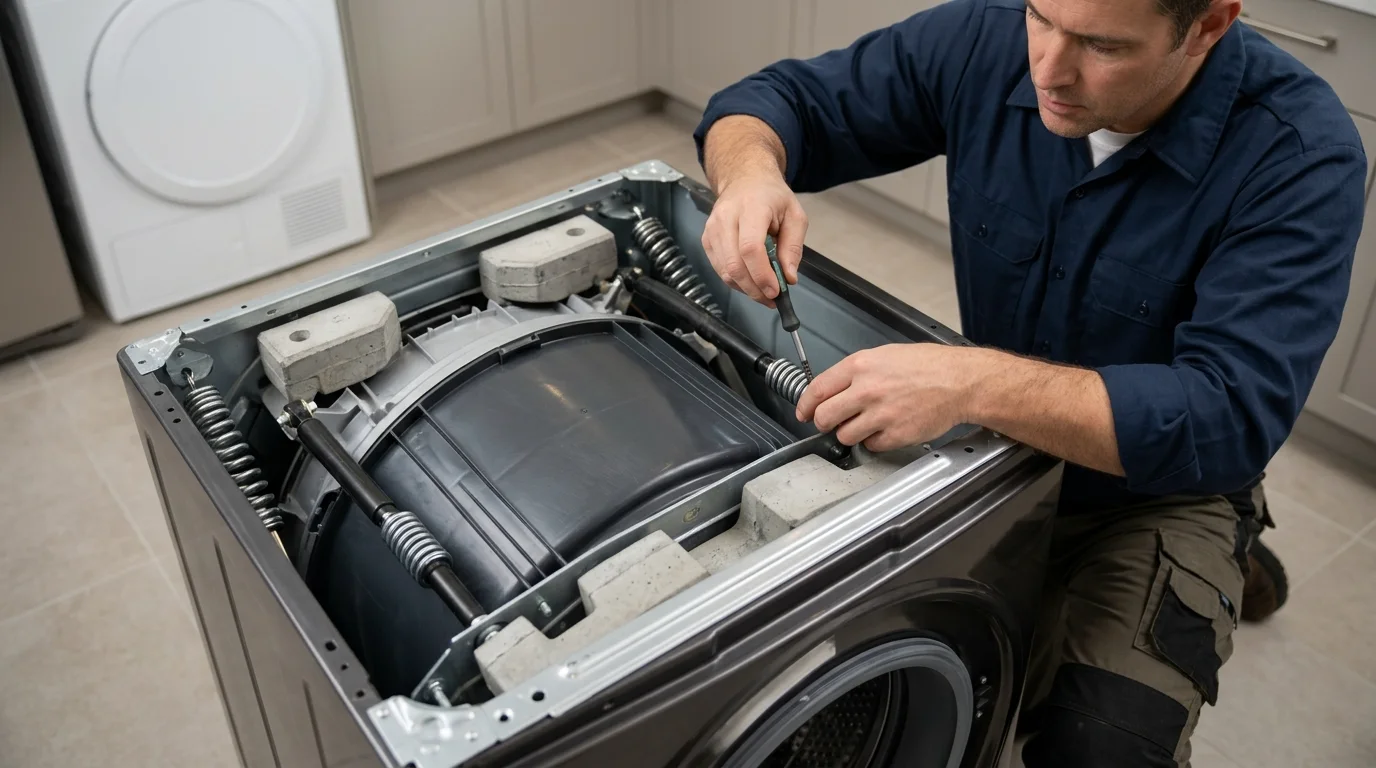
They do not prove the suspension rods or shock absorbers are worn. They do not prove a balance sensor is defective. They do not prove the motor or control board has failed.
Those are possible machine-side causes when imbalance is persistent, but the display cannot separate them. The same code can be produced by a bad load, an unstable washer, worn support components or a sensing problem because all of those conditions can prevent safe high-speed spin.
This is why parts-shopping from an error code is unreliable. The code identifies the problem category. The behaviour across different loads is what tells you whether to keep looking at the laundry or start testing the machine.
Common Mistakes That Keep the Error Returning
- Washing one heavy item by itself. A single saturated item can stay on one side of the basket.
- Adding more items to an already overloaded drum. More weight is not the same as better balance.
- Ignoring a washer that rocks on the floor. Stable foot contact matters during spin.
- Repeating the same failed load as the only test. Use a normal balanced load to see whether the problem follows the washer.
- Replacing suspension parts from UE or Ub alone. The code does not identify the failed component.
When a Persistent Imbalance Error Points to the Washer
Once load size, distribution and levelling have been corrected, repeated errors become more meaningful. A technician may need to inspect how the basket or drum is supported and how much movement occurs under a normal load.
Top-load and front-load washers use different support systems, so one generic suspension diagnosis does not apply to every Samsung model. Depending on the platform, a technician may inspect support rods or dampers, springs, tub position, drive behaviour and physical signs of contact or wear.
If mechanical support looks normal, sensing and control can also matter. The washer relies on motor and control feedback to judge spin conditions. Wiring, speed feedback and model-specific control logic may need testing when the machine repeatedly rejects a balanced load.
What to Check After the Error Clears
Do not judge success only by whether UE or Ub disappeared from the display. Check whether the washer reaches a normal spin, whether the cabinet remains stable, whether cycle time returns to normal, and whether clothes come out reasonably spun.
If the code clears but the washer still shakes violently or leaves ordinary loads soaking wet, the balance problem may still be present. If it runs normally on several balanced loads, the original event was more likely a load condition than a machine failure.
What to Record Before Requesting Service
Write down which code appeared, what was in the washer, whether the load was small, bulky or mixed, and whether the machine physically moved. Note whether redistributing the laundry helped and whether the error returned with a different normal load.
Those observations show whether the problem is repeatable and help prevent a service visit from starting with an assumption that the code itself identifies a failed suspension part.
If UE or Ub Started After the Washer Was Moved
A move can change more than the washer’s location. A levelling foot may no longer carry weight, the floor may be less rigid, the cabinet may be touching a wall or shelf, or installation steps required for that model may need to be repeated. If the error began immediately after relocation, inspect setup before assuming an internal suspension part failed at the same moment.
Check the installation instructions for the exact model, especially if shipping hardware, a pedestal, stacking arrangement or calibration procedure applies. Do not use a calibration button sequence copied from another Samsung washer, because the procedure is model-dependent.
Why Clothes Can Come Out Soaking Wet After an Imbalance Error
An unbalanced washer may deliberately avoid full spin speed. That means the tub can be drained while the laundry still holds much more water than normal. Soaking wet clothes after UE or Ub are therefore consistent with an interrupted or reduced spin and do not automatically prove a drainage fault.
If there is also standing water in the tub, then drainage becomes a separate concern. If the tub is empty but the clothes are heavy with water, focus first on why the washer could not complete high-speed spin.
When Vibration Matters Even Without the Code
A washer that regularly bangs, walks or shakes violently deserves attention even if UE or Ub does not appear every time. The display is only one signal. Repeated excessive movement can stress hoses, wiring, cabinet parts and the support system over time.
If normal loads require frequent manual redistribution or the machine cannot remain stable despite correct levelling, record that pattern. A technician can then evaluate the support and sensing systems under conditions that reproduce the complaint instead of waiting for a specific code to appear.
When to Request Appliance Repair
If UE or Ub continues across normal balanced loads after the washer is confirmed stable and level, Request Appliance Repair. Service is also appropriate if the washer bangs heavily, walks across the floor, cannot reach normal spin, or repeatedly leaves ordinary loads unusually wet.
The goal of the assessment is to determine why the machine cannot maintain balance, not simply to clear the display. Once the load and installation variables are ruled out, the remaining mechanical and electronic systems can be tested in a logical order.
Need Appliance Repair?
Share the appliance, brand, address, symptoms and optional photos online. A contractor can review the request and contact you about availability and next steps.
Start Your Repair Request