
Bosch Dishwasher E24 and E25 Drain Errors
Bosch Dishwasher E24 Code guide: learn the key details, compare options, check verified sources, and make a safer decision before you act.
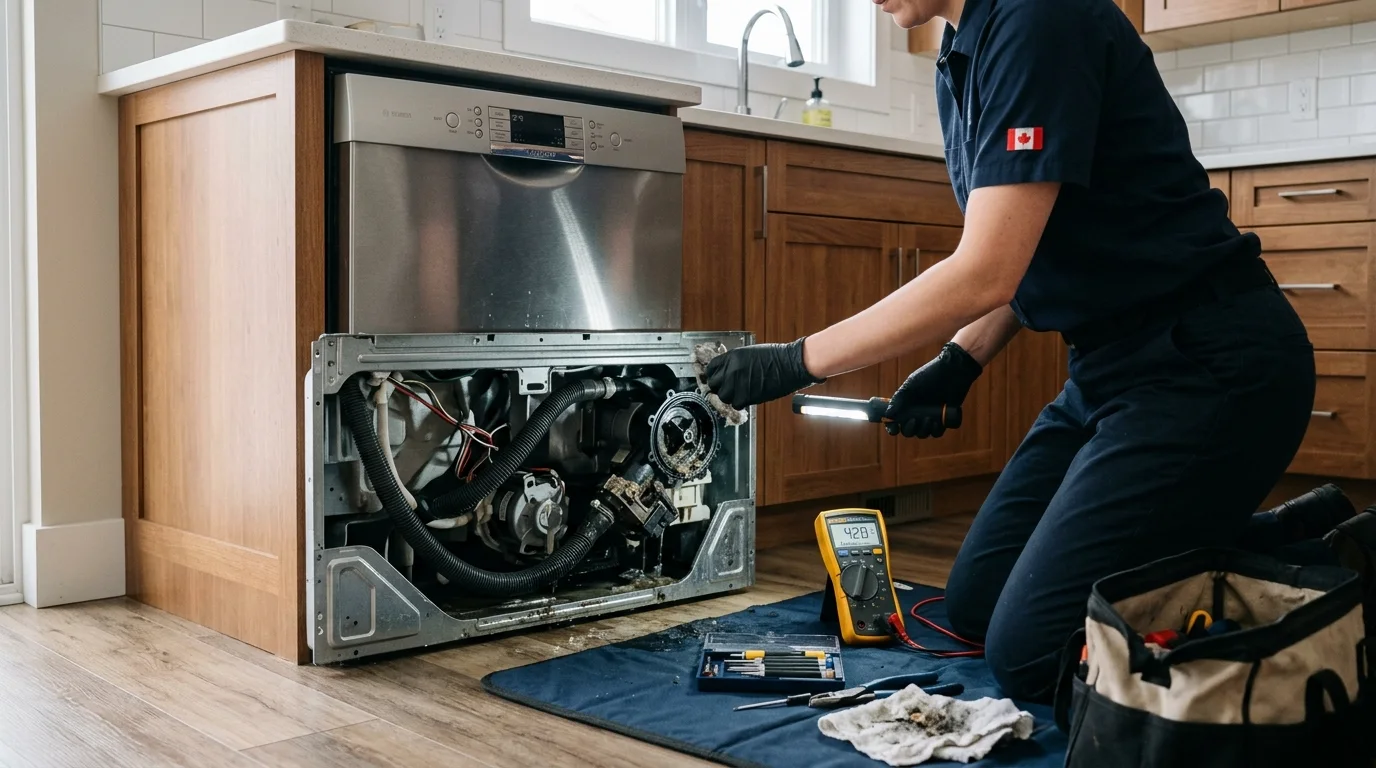
A Bosch dishwasher E24 code means the dishwasher is not draining normally. E25 is related and Bosch ties it more directly to the drain-pump area. Neither code proves one failed part, so the useful first step is to follow Bosch’s documented drain-path checks before treating the pump motor or control as the diagnosis.
What Does the Bosch Dishwasher E24 Code Mean?
A Bosch dishwasher E24 code means the appliance is not draining normally. According to Bosch’s official support documentation, the checks include the drain filter, drain hose, pump-cover condition and installation-related blockage such as a garbage-disposal knockout plug that was not removed. E24 does not prove that any specific component has failed outright. It tells you that the dishwasher is not draining as expected and that the drain system needs to be checked systematically. Exactly where depends on what a closer look reveals. Always check your model-specific owner manual, as code definitions and component locations can vary across Bosch dishwasher series.
E25 is a related but distinct code. Bosch officially defines E25 as a blocked drain pump or a loose or missing drain pump cover. E25 is more explicitly tied by Bosch to the pump area, while E24 support material covers several drain-path checks. Bosch also groups the codes similarly on some support pages, so the exact owner manual remains the best reference for your model. The two codes share several accessible drain-system checks.
What Bosch’s Official Documentation Actually Says
Bosch’s current owner support pages describe E24 as a drainage failure that can result from a blocked filter, an obstructed or kinked drain hose, a loose drain pump cover, or a blocked garbage-disposal connection. The machine monitors whether water is evacuating during the drain phase; when the control board determines that it is not, it displays E24 and halts the cycle.
E25, per the same official source, points specifically to the drain pump, either a blockage in the pump itself or a pump cover that is loose or missing. A loose pump cover allows air to bypass the pump during the drain phase, which prevents the pump from moving water effectively even if the impeller is unobstructed.
Neither code tells you exactly which component caused the problem. Both direct you to inspect the same general area, the filter, pump, and drain-path connections, before concluding that a part needs to be replaced.
Symptoms That Commonly Appear With E24 and E25
A common sign accompanying a Bosch dishwasher E24 code is standing water at the bottom of the tub after a cycle ends or after the dishwasher stops mid-cycle. You may also notice the dishwasher pausing unexpectedly, the cycle not completing, or gurgling and humming sounds during the drain phase as the pump struggles against a restriction.
With E25 specifically, an unusual mechanical noise, sometimes described as a buzzing or grinding sound from the pump area, can appear if debris is partially obstructing the pump impeller. In some cases the pump runs audibly but water does not move, which is a sign the impeller is blocked or the pump cover is not seated correctly.
If the dishwasher clears water when you manually run a drain or cancel cycle but E24 or E25 returns during a normal wash, the restriction is likely partial rather than complete. A partial obstruction can be harder to locate, which makes the accessible drain-path checks below a useful starting point.
When the Code Appears Can Narrow Where to Look First
The timing of the first error can help you choose a sensible starting point without turning the code into a parts diagnosis. If E24 appears right after a new garbage disposal or sink-plumbing change, check the household drain connection and hose routing first. Bosch specifically includes an unremoved disposal knockout plug among the conditions that can block dishwasher drainage.
If the code started after the filter or pump-cover area was cleaned, recheck that the parts were returned to the position shown in the owner manual for your exact model. A cover that is loose or not seated as designed can interrupt drainage even when the pump motor itself is healthy.
When the error developed gradually or appears only on some cycles, a partial restriction in the filter, drain path, hose, or pump area remains possible. That pattern is useful evidence, but it still does not prove whether the pump, wiring, or control system is at fault. The next step is to inspect the accessible drain path systematically, then move to model-specific service testing only if the code returns.
Common Cause Groups for Bosch E24 and E25 Codes
Drain errors on Bosch dishwashers generally fall into one of four cause groups. Understanding the groups helps narrow the likely location without assuming a specific part has failed.
The first group is filter and sump restrictions. Food debris, broken glass, and accumulated grease can clog the fine mesh filter and the coarse flat filter at the bottom of the tub. Filter and sump restrictions are a common place to start because they are accessible and directly involved in the drain path.
The second group is drain hose restrictions. The flexible hose that carries wastewater from the pump to the sink drain or garbage disposal can become kinked behind the cabinet, especially if the dishwasher has been pushed back in or moved. Drain-hose routing and connection height should be checked against the installation instructions for the exact dishwasher, because a kinked, compressed, or incorrectly routed hose can restrict flow.
The third group covers pump area issues, which E25 points to more directly. Debris can reach the pump impeller through a dirty filter or through a foreign object that bypassed the filter. A loose or improperly seated pump cover prevents the pump from building enough suction to move water out. In some cases the pump impeller itself can be damaged by a hard object such as a bone fragment or broken glass.
The fourth group involves the siphon or connection point at the sink drain or garbage disposal. A blocked air gap fitting, a blocked garbage-disposal drain connection, or a disposal where the knockout plug was never removed at installation can prevent water from leaving the machine even when the pump is functioning correctly.
Safe Checks a Homeowner Can Make
The following checks do not require disassembly beyond removing the filter and inspecting accessible connections. Bosch’s own troubleshooting guidance covers these steps for both E24 and E25.
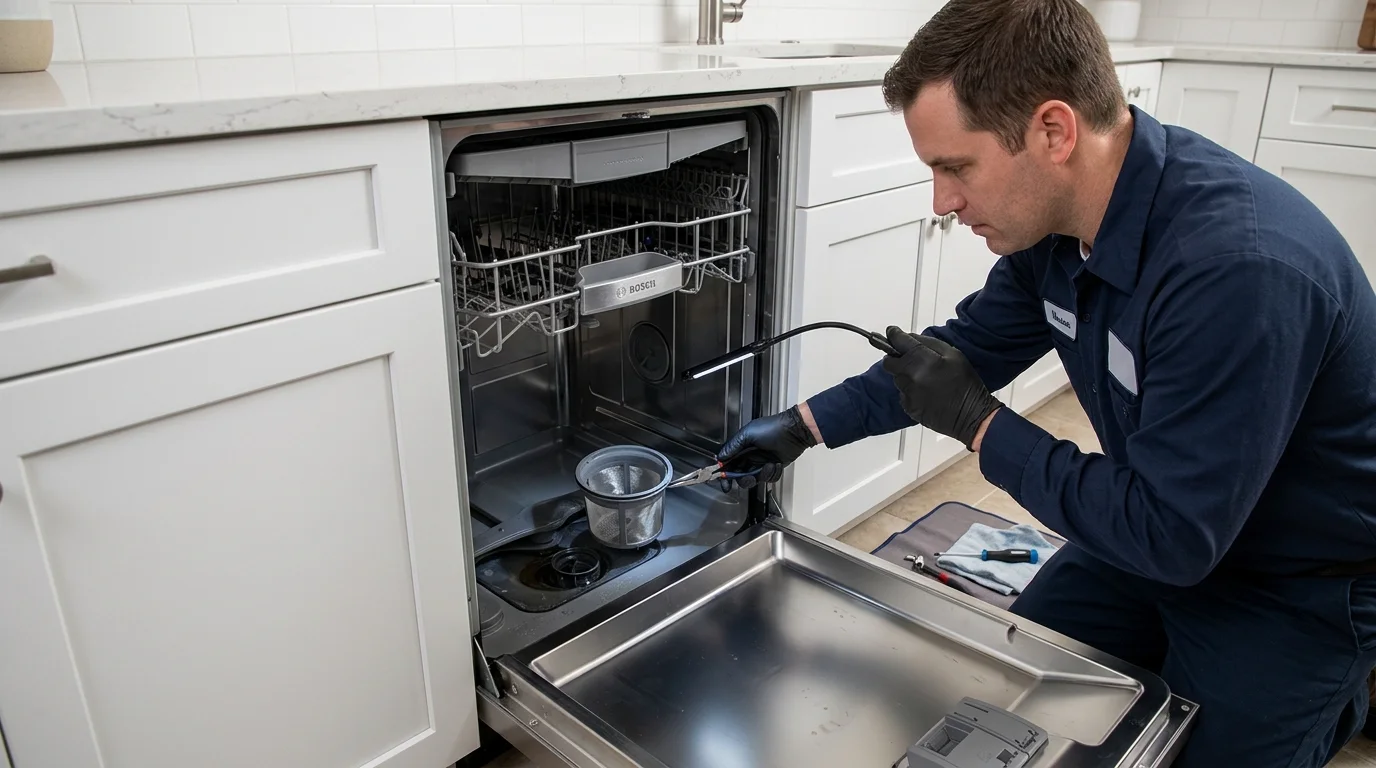
Start with the filter using the removal method shown in the owner manual for your exact Bosch model. Clean the accessible filter surfaces and inspect the surrounding area for debris without forcing parts that do not move as the manual describes. Filter and pump-cover access varies by series, so model-specific instructions take priority over a generic removal sequence.
Once the filter is out, look at the pump cover. It sits at the bottom of the tub and is usually secured by clips. If the pump cover appears loose or out of position, use the owner manual for your exact model to confirm how it should be seated. Bosch identifies a loose or missing pump cover as an E25 cause, so do not force the cover if the access or locking method is unclear.
Next, check the drain hose routing if you can do so safely without pulling the appliance away from the wall. Look for any visible kink or compression behind the cabinet. If the hose connects to a garbage disposal, confirm the disposal’s knockout plug was removed at installation. A plug left in place is a surprisingly common cause of drain errors that appears immediately after a new disposal is installed.
Finally, inspect the accessible sink-side drain connection if your installation has an air gap, siphon connection, or disposal connection. Look for obvious blockage or backflow, but do not disconnect plumbing fittings unless you are comfortable doing so and the installation instructions support the step.
After completing the accessible checks, restore the dishwasher to normal condition and follow the reset or test instructions in the owner manual for your exact model. Reset procedures vary by series, so avoid relying on a generic button sequence.
What the Code Does Not Prove
A Bosch dishwasher E24 or E25 code tells you the drain system is not working as expected. It does not confirm that the drain pump motor has failed, that the control board is faulty, or that any component needs to be replaced. The code is the starting point of a diagnosis, not the conclusion.
This matters because a pump that runs but produces no flow could be obstructed by debris rather than mechanically failed. Replacing the pump without clearing the obstruction first would not resolve the problem. Similarly, a loose pump cover produces pump-area symptoms identical to a failing pump, but the fix takes seconds rather than a parts order.
Bosch support pages can group E24 and E25 checks somewhat differently, and physical access varies by dishwasher series. Use the code as a drain-system clue, then verify the exact meaning, access steps, and reset procedure in the owner manual for your model. Bosch makes manuals searchable through its owner manual library.
What to Record Before Resetting the Code
If the code is intermittent, a few details are worth recording before you reset the dishwasher again. Write down whether the display showed E24, E25, or both at different times, and note whether standing water was still visible in the tub. The exact code and the amount of water left behind give the technician more useful starting information than a general description that the dishwasher stopped.
Also note when the error appears. A code that shows up immediately after a new garbage disposal, sink-plumbing change, dishwasher reinstallation, or filter cleaning puts different checks near the top of the list. If nothing changed recently, record whether the pump can be heard during the drain phase, whether any water moves, and whether a cancel or drain command removes some of the standing water.
Do not repeatedly run full wash cycles just to reproduce the fault when the tub is not draining. One clear observation of the code, water level, recent changes, and drain behaviour is usually more useful than several additional failed cycles. The goal is to preserve evidence that helps narrow the drain path without turning the error display into a do-it-yourself component diagnosis.
A quick photo of the display and the standing-water level can also help if the code disappears before the service visit. If you can do so without moving the dishwasher, photograph any recently changed sink or disposal connection as well. These records are not a substitute for diagnosis, but they can preserve details that are easy to forget once the machine has been reset or the water has been removed.
What a Technician May Test
If the accessible checks do not resolve the error, a professional assessment can separate a real pump failure from a restriction, wiring problem, or control-side issue without replacing parts based on the display alone.
A technician can verify whether the drain pump is being commanded to run, whether it actually moves water under that command, and whether the impeller or pump housing is obstructed or damaged. The full drain path can also be checked from the pump outlet through the hose and into the household connection, including sections that are not safely accessible from the tub.
If the drain path is clear but the code persists, the next checks depend on the exact Bosch platform. Wiring, connectors, pump electrical readings, and control outputs can be compared with the model-specific service information. That process matters because E24 and E25 narrow the diagnostic area, but they do not identify one failed component by themselves.
When to Request Appliance Repair
If the accessible homeowner checks, filter cleaning, pump cover inspection, drain hose check, and garbage-disposal connection review, do not resolve the Bosch dishwasher E24 or E25 code, requesting a professional assessment is the practical next step. At that point the cause is likely internal to the machine or related to a component that requires disassembly to inspect safely.
It is also sensible to request professional service before attempting further investigation if you are not comfortable working around standing water and electrical components, if the dishwasher is under warranty and you want to protect coverage, or if the code returns repeatedly over a short period even after the accessible checks are completed.
A trained technician can identify whether the issue is a mechanical failure, a control issue, or a plumbing connection problem, and can advise on whether repair or replacement is the more practical option based on the age and condition of the appliance.
If your Bosch dishwasher is showing an E24 or E25 drain error and the initial checks have not resolved it, Request Appliance Repair to have a technician assess the appliance. For more on Bosch appliance faults and service in Toronto, see our Bosch appliance repair Toronto page, or visit our dishwasher repair Toronto service page for general dishwasher diagnosis and repair.
Need Appliance Repair?
Share the appliance, brand, address, symptoms and optional photos online. A contractor can review the request and contact you about availability and next steps.
Start Your Repair Request