
Washer Won’t Spin: Common Causes and Repair Clues
Washer not spinning? Use load balance, drainage, door or lid recognition and drive behaviour to narrow the cause before replacing internal parts.
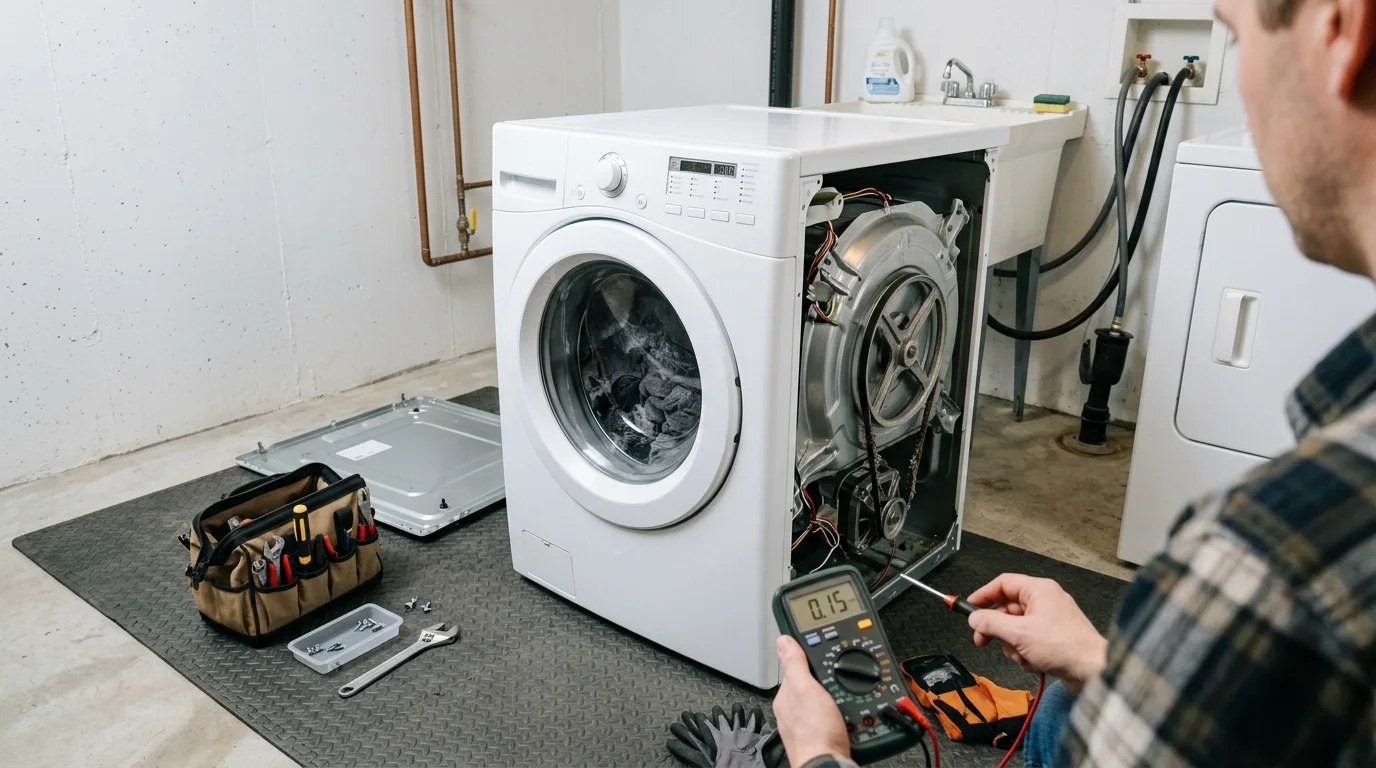
A washer that won’t spin is easier to narrow when you look at what happened before the spin phase. Load balance, standing water, door or lid recognition, cycle settings and drive behaviour can create similar outward symptoms, so the no-spin complaint should be mapped to the washer’s full cycle behaviour before an internal part is blamed.
Washer Not Spinning: What the Symptom Can Mean
A washer not spinning can come from several cause groups: an unbalanced or overloaded load, a lid or door interlock that has not engaged, a drain or pump problem that prevents the machine from advancing, or a worn or failed drive component such as a belt, motor coupling, or motor. In some cases the spin cycle was set to low or disabled by accident. The symptom alone does not prove which cause applies, and testing is the reliable way to confirm it.
Safety and Stop-Use Warning Signs
Most spin problems are not immediate safety emergencies, but a few symptoms mean the washer should not be run again until it has been assessed by a technician.
- Burning smell during or after a cycle. A burning rubber or electrical smell deserves caution because several drive or electrical faults can produce heat or odour. Stop using the machine and unplug it until the source is identified.
- Visible sparking, smoke, or scorching near the plug, cord, or control panel. Unplug the washer if it is safe to do so and do not restart it until it has been assessed.
- Standing water combined with a humming sound and no drum movement. Stop repeatedly restarting the cycle. A drainage or mechanical problem may be preventing the machine from advancing normally.
- Loud banging or grinding at the start of spin that is not caused by a loose item in the load. Stop the cycle and check the load before running the machine again.
- The washer moves significantly across the floor during spin. A machine that walks or shifts position should be levelled and the load checked before another full-speed spin.
Symptom Patterns That Help Narrow the Problem
How the spin fails gives useful clues. Note what the washer does before, during, and after the point where spin should begin.
- The washer fills and agitates normally, then skips spin entirely. This can point toward a lid or door interlock issue, a cycle-setting problem, or an internal drive/control fault.
- The washer fills and drains, but will not spin. If water exits normally but spin does not follow, the drainage system becomes less likely than an interlock, drive, motor, sensor, or control issue.
- The washer tries to spin, slows, and stops before reaching full speed. An unbalanced load can cause this pattern, but drive, motor, suspension, or control problems can look similar.
- The washer stops with standing water in the drum. A drainage restriction or pump problem moves higher on the list because many washers will not proceed normally to spin until enough water has drained.
- The drum does not move, but a humming sound is present. The sound alone does not identify the failed component. Internal testing is needed to distinguish mechanical resistance, drive faults, motor issues, and other causes.
- The drum spins, but clothes come out unusually wet. Confirm the selected spin speed and load balance first. If the symptom continues, the washer may not be reaching or maintaining normal spin speed.
Common Cause Groups
Washer spin problems fall into a few broad groups. Thinking in cause groups is more useful than assuming one part has failed from the symptom alone.
Load and Setup Issues
An unbalanced or overloaded load can reduce spin performance, and low-spin or no-spin settings can leave clothes wetter than expected. Excess suds can also interfere with normal operation on some machines. Whirlpool’s washer not spinning troubleshooting guidance lists cycle settings, excess detergent, imbalanced loads, overloading, levelling, power interruptions, drain-hose problems, and an open door or lid among possible causes to check. Use your own model’s manual for model-specific instructions.
Lid and Door Interlock Issues
Washers use a lid or door interlock so the machine does not enter normal operation with the access point unsecured. If the interlock does not engage or the control does not receive the expected signal, spin may not begin. A door that will not latch normally or a visibly damaged latch is useful information to give a technician, but the symptom still requires testing before a part is condemned.
Drain and Pump Issues
Standing water changes the diagnosis because incomplete drainage can prevent the cycle from progressing normally. A kinked drain hose is an accessible check. Pump filters, pump faults, internal restrictions, and installation details vary by model, so disassembly should be left to the appropriate service procedure.
Drive System Issues
Depending on the washer design, power may be transferred through a belt, coupling, clutch, direct-drive arrangement, or other components. Wear or breakage in that path can prevent the basket or drum from reaching normal spin speed. Squealing, abnormal resistance, or a burning odour are clues, not proof of a specific failed part.
Motor, Control, and Sensor Issues
A motor, motor-control system, speed or position sensor, wiring fault, or main control issue can also interrupt spin. These possibilities overlap in their outward symptoms and usually require model-appropriate diagnostic testing rather than visual inspection alone.
Why a Spin Problem Can Look Like a Different Fault
The spin phase depends on more than the part that physically turns the drum. The washer also has to recognize the selected cycle, confirm the lid or door condition, manage the load, remove enough water, and receive the signals it expects from the drive and control systems. A problem earlier in that chain can therefore appear to be a spin failure even when the drive components themselves are still capable of turning.
That is why standing water, an unlocked door, a severely unbalanced load, and a true drive failure should not be treated as interchangeable diagnoses. The outward result may be similar, but the repair path is different. A useful description of the sequence is often more valuable than a guess at the failed part.
Watch What Happens Immediately Before Spin
If the machine drains normally and then becomes quiet when spin should start, that is a different pattern from a washer that never finishes draining. A washer that starts to accelerate and then repeatedly backs off is also different from one whose drum never attempts to move. Record those differences. They help separate a cycle-control decision, load-balance response, drainage problem, and mechanical or electrical drive fault.
Compare an Empty or Light Load With the Problem Load
If the washer behaves differently after the load is redistributed or reduced, load balance or loading becomes more relevant. If the same symptom occurs with a normal small load, the cause is less likely to be explained by a one-time imbalance alone. Do not keep repeating test cycles if the machine is grinding, overheating, leaking, sparking, or moving violently.
Safe Checks a Homeowner Can Make
Start with checks that require no panel removal or electrical testing. Use the model’s owner manual whenever its instructions differ from general guidance.
- Check the spin setting. Confirm that a low-spin or no-spin option was not selected unintentionally.
- Redistribute the load. Spread laundry more evenly and remove items if the drum is tightly packed.
- Confirm the lid or door closes normally. Do not bypass or defeat a lid or door safety interlock.
- Look at the accessible drain hose. Check for a visible kink, crushing, or obvious installation problem without disconnecting anything unnecessarily.
- Check power. If the washer has lost power, follow the manufacturer’s restart guidance and your electrical panel’s normal operating instructions. Repeated breaker trips or electrical odours require professional attention.
- Record any displayed error code. Check the owner’s manual for your exact model rather than assuming a generic code meaning applies.
If these accessible checks do not change the symptom, the remaining causes generally require internal inspection or testing.
Washer Design Changes Which Causes Deserve Attention
The words “washer not spinning” describe the symptom, not one universal mechanism. A front-load washer, a traditional top-loader, a high-efficiency top-loader, and a direct-drive design can use different interlocks, drive components, sensors, and control logic. Even two machines from the same manufacturer can behave differently when a load is unbalanced or drainage is incomplete.
That is why model-specific instructions matter once troubleshooting moves beyond the basic checks. A component that is common on one design may not exist on another. The owner’s manual can clarify normal cycle behaviour, accessible filter locations where applicable, reset instructions, and the meaning of a displayed code. Internal service procedures should be matched to the exact model rather than borrowed from a similar-looking washer.
This also helps explain why a symptom list should be used to narrow the system, not to order a part. If the washer drains normally, recognizes the closed door, and still cannot begin or maintain spin, the remaining diagnostic path depends heavily on how that particular machine senses and drives the drum.
What to Note Before Calling a Technician
A short, accurate symptom record can make the first assessment more efficient. You do not need to diagnose the washer yourself. Note what you can observe safely:
- whether water remains in the drum when the cycle stops
- whether the washer attempts to spin at all
- whether the problem happens on every cycle or only certain settings
- whether the load was unusually heavy, bulky, or unbalanced
- any displayed error code, copied exactly as shown
- new sounds such as squealing, grinding, repeated clicking, or humming
- any burning odour, leaking, breaker trip, or unusual movement
- the model number if it is available without moving or dismantling the appliance
These observations help a technician choose the right diagnostic starting point. They also reduce the risk of a vague description such as “it does not work,” which leaves several unrelated systems equally plausible.
What Not to Attempt Yourself
Once troubleshooting requires removing panels, reaching moving drive components, testing live electrical circuits, bypassing a lid or door interlock, or forcing the washer to operate with a safety device defeated, the job has moved beyond a simple homeowner check. The same applies when the machine shows electrical burning, sparking, repeated breaker trips, severe mechanical noise, or uncontrolled movement.
Do not bypass a door lock or lid switch to see whether the washer will spin. Do not reach into a machine while it is energized, and do not keep restarting a washer that is showing a stop-use warning sign. The goal of surface-level troubleshooting is to rule out simple conditions safely, not to reproduce a technician’s internal diagnostic procedure.
What a Technician May Inspect or Test
A technician diagnosing a washer not spinning uses the symptom pattern and model design to decide what to test rather than replacing parts by guess.
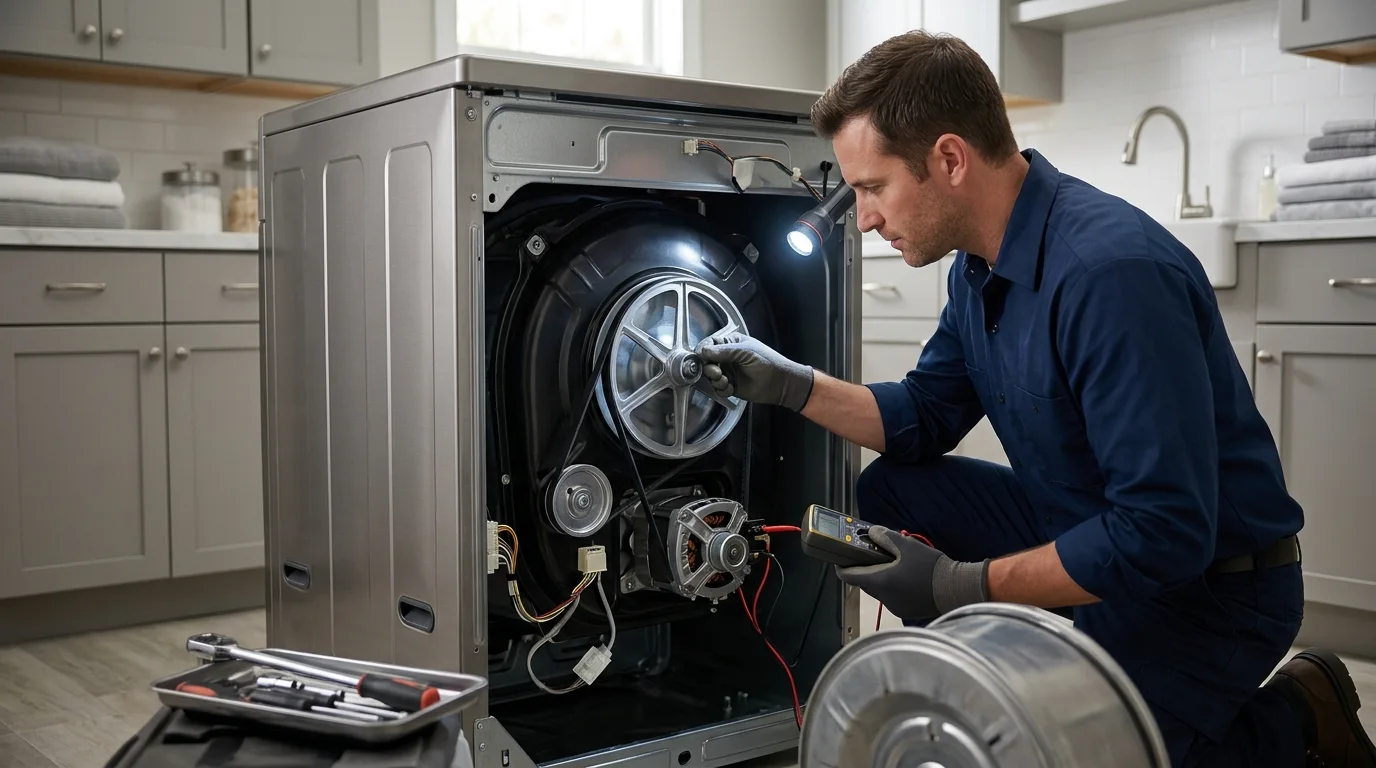
- Lid or door interlock. The interlock and its signal can be checked to determine whether the machine is receiving the condition needed to proceed.
- Drain system. The hose, accessible filter where applicable, pump operation, and drainage behaviour can be checked when standing water or slow draining is part of the symptom.
- Drive components. Belt, coupling, clutch, pulley, or other drive components may be inspected according to the washer’s design.
- Motor and motor control. If the mechanical drive path is intact, testing may move toward the motor, motor-control system, wiring, and related protection circuits.
- Speed or position feedback. Electronic washers may use sensors to report drum or motor movement to the control system.
- Drum, bearing, and suspension condition. Abnormal resistance, grinding, looseness, or excessive movement can shift attention toward mechanical support components.
This sequence is why a professional assessment is more reliable than replacing the part that sounds most likely from a symptom list. Several faults can create almost the same behaviour from the outside.
Repair or Replace: What a Spin Fault Actually Means for the Decision
The right decision depends on what actually failed. A latch, belt, pump, control, motor, bearing, or other fault can involve very different labour, parts availability, and repair scope.
A common rule of thumb is to compare the repair estimate with the cost of a comparable replacement, but there is no single percentage or age that makes the decision automatically. Consider the washer’s age, overall condition, repair history, the failed component, parts availability, and the cost and features of a suitable replacement. Diagnosis comes first because the same spin symptom can lead to very different repair estimates.
A technician assessment gives you a confirmed fault and an estimate to use in that decision without committing you to a repair.
When to Request Appliance Repair
If the accessible checks do not resolve the problem, or if you notice burning odours, sparking, repeated electrical trouble, severe movement, grinding, or another stop-use warning sign, professional assessment is the sensible next step.
You can Request Appliance Repair to connect with a contractor who services your area, or visit the washer repair Toronto page for more information about washer repair service.
Need Appliance Repair?
Share the appliance, brand, address, symptoms and optional photos online. A contractor can review the request and contact you about availability and next steps.
Start Your Repair Request